
Researched and Written by: Don Goss
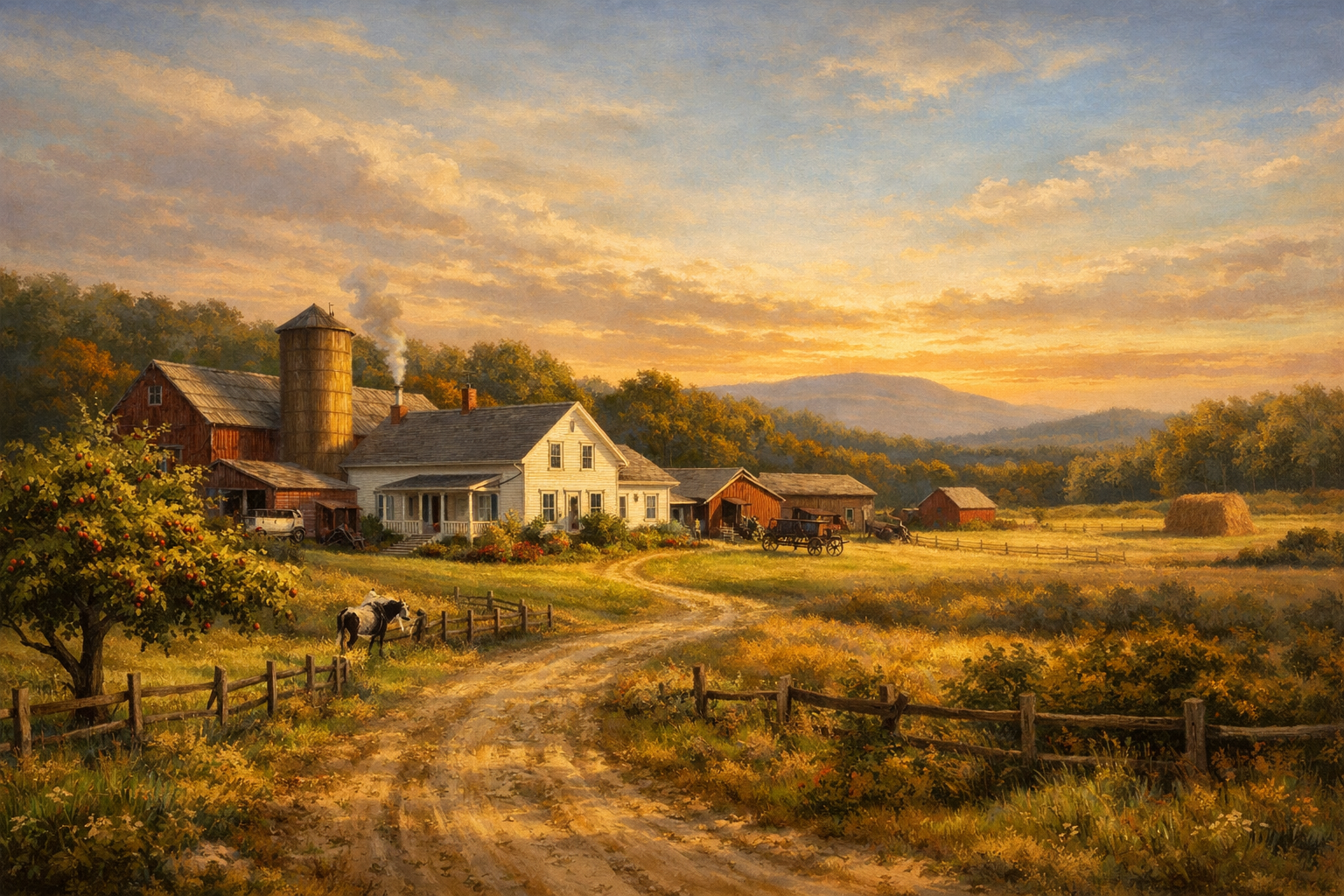
The house had stood on Harris Hill long before the Goss family ever saw it, known to everyone in the area as the Nelson Haskell place. Built around 1870, it carried the confidence of a home raised by capable hands—solid lines, thoughtful planning, and woodwork that glowed warmly even in winter’s thin light. The front entrance opened into a generous hall, the kind that seemed to welcome you with a breath of cool air in summer and the faint scent of woodsmoke in winter. Parlors waited on either side, their doors tall and dignified, as though expecting company at any moment.
A graceful staircase curved upward to the second floor, where three large bedrooms looked out over the fields and pastures. Their closets were deep, their windows wide, and from the upstairs hall a door led into an attic so large it felt like a secret world above the rest of the house.
Downstairs, the hall flowed into a broad dining room. From there, doors opened into two more bedrooms and another led down into the cellar—a cool, shadowed space with a room set aside for storing the farm’s produce. The pantry stood just off the dining room, and at the far end the kitchen door opened into Ruby Goss’s domain. Beyond the kitchen stretched a long shed, a rambling structure that held the laundry area, the carriage space, the workbench, the loft overhead, the woodshed, and the outdoor toilet. It was the kind of shed that grew with the needs of a family, one room at a time.
The outbuildings formed a small village of their own: a large shop, a manure shed, and a barn big enough to swallow sound. Inside were cattle tie‑ups, a horse area, a towering silo, hay mows, lofts, and a broad barn floor where the dust rose in golden clouds when the sun slanted in.
The Land Around Them
The farm stretched for half a mile along the road from Poland Corner over Harris Hill. The land rolled gently, opening into fields, the house field, and a rocky pasture that had been cleared by stubborn hands long before the Goss family arrived. To one side lay the well‑kept farm of Abbot and Mrs. Russell; to the other, a poor road that wandered off into the woods and ended at the abandoned home of Percival Hunt, left empty since the mid‑1920s.
The Goss farm held six fields, all in good cultivation. Two fronted the road, two smaller ones lay behind them, and the front pasture wrapped around the whole cluster. A farm road wound through this pasture to the Back Field and Long Field, half a mile from the house. Most of the land lay level, except for the Back Field, which sloped westward toward the wooded pasture beyond. A two‑acre orchard stood near the house field, its trees bending with fruit in good years.
The front pasture was half woods, half rough grazing land. The back pasture was mostly a wooded hillside. In all, the farm covered 120 acres—15 acres in the four front fields, 25 in the two back fields, and the rest in pasture, some rough but cleared, some thick with timber.
The price for all of it was $3,600, secured with a private mortgage. Harry Goss, careful and steady, always met his payments, though during the Depression he sometimes asked to postpone the principal when times were tight. The lender agreed. The sale of rocks in 1927 helped reduce the debt, and by the early 1930s the mortgage had fallen to about $2,000.
Life in the Harris Hill Home
For all its beauty, the house did not offer luxury. It offered promise—and the hard work that came with it. The parlors, built for company, were quickly repurposed: one became the family sitting room, the other a bedroom. Chimneys threaded through the house, but only the kitchen‑dining chimney was used regularly. The living‑room chimney saw occasional fires; the rest of the house stayed cold.
The kitchen held a plain black sink that drained into a cesspool. Water came from the well, carried in pails and kept in a bucket beside the sink. Hot water lived in the stove’s reservoir, available only when the fire was burning. The oil stove and treadle sewing machine were prized possessions, and the arrival of the telephone felt like a small miracle.
Floors were covered in linoleum, with an “art square” rug in the living room. The walls were papered when money allowed. One spring, while the boys visited their aunts, Ruby used the payout from an old insurance policy to have the interior painted and papered. They returned to a home transformed.
Winters were a test of endurance and ingenuity. The foundation was banked with sawdust and brush. Beds were piled with quilts, and soapstones or flatirons were heated and slipped beneath the covers. Dressing in the morning meant a quick sprint to the nearest warm room. Yet even in the coldest nights, the family felt secure—“as snug as a bug in a rug,” as they liked to say.
The furniture was practical, worn but dependable. A Morris chair sat in the living room, as it did in so many homes of the time. Ruby often dreamed of adding another window to brighten her dark kitchen, but the money never stretched that far.
Still, the house held them. It sheltered their work, their hopes, their hardships, and their laughter. It was not luxury—but it was home.