
Researched and Written By: Don Goss
Harry Adrian Goss arrived in Greene, Maine, not as a pioneer or a stranger, but as a young man carried forward by the long, steady current of his family’s journey. In 1890, the Goss family—James and Sarah, their son Elmore, their daughters Idy and Alida, and young Harry—left the ridge country of Auburn behind them and came down into Greene. They had already lived several lives in several places: two years on Perkins Ridge, and before that on the old Ross farm in Poland, where Sarah True Ross had been born, raised, and rooted.
Sarah had never known another home until she married James Fowler Goss of Minot in 1868. The newlyweds stayed on her father’s farm, caring for him through his final years. Only after his passing in 1888 did they finally step away from that chapter of their lives. By the time they reached Greene, they had already weathered the quiet hardships and small triumphs that shape a family.
Their first task in Greene was to manage the town farm, a responsibility they carried for two years. Then came the purchase of the Valley Farm in the Mower neighborhood—a place with rolling fields, a good stand of timber, and the promise of permanence. It became the family’s true home.
The children began to scatter as children do. Idy married Herbert Davis and settled nearby. Alida married Herbert Wright and also stayed close. Elmore struck out farther, heading to Easton, Massachusetts, where he built a life of his own. Only Harry remained at home, steady and rooted. He entered into a formal agreement—written, witnessed, and recorded—to care for his parents for the rest of their lives in exchange for the farm that had become the heart of the family.
When Sarah True Ross Goss died on December 1, 1905, the house felt emptier, but life pressed forward. Harry married Abbie Blaisdell the next year, and together they welcomed three children. Their joy was short‑lived. The youngest, Paul Harry, died in infancy, and Abbie herself passed away soon after, on April 9, 1910. It was a blow that might have broken a lesser man. But Harry, with his quiet endurance, continued on. In 1911 he married Ruby Edwards of New Gloucester, and the family circle began to mend.
From Greene to Harris Hill
When Harry took over the farm, he proved himself a capable and ambitious farmer. He expanded steadily, taking on more land as his family grew and his needs increased. After tuberculosis claimed his sister Alida and her husband Herbert Wright, Harry stepped in to help manage their place as well. He also acquired the Smith Place near Patten School, dividing his time and labor among three farms. For a while, he made it work—through long days, careful planning, and the kind of stubborn determination that farming demands.
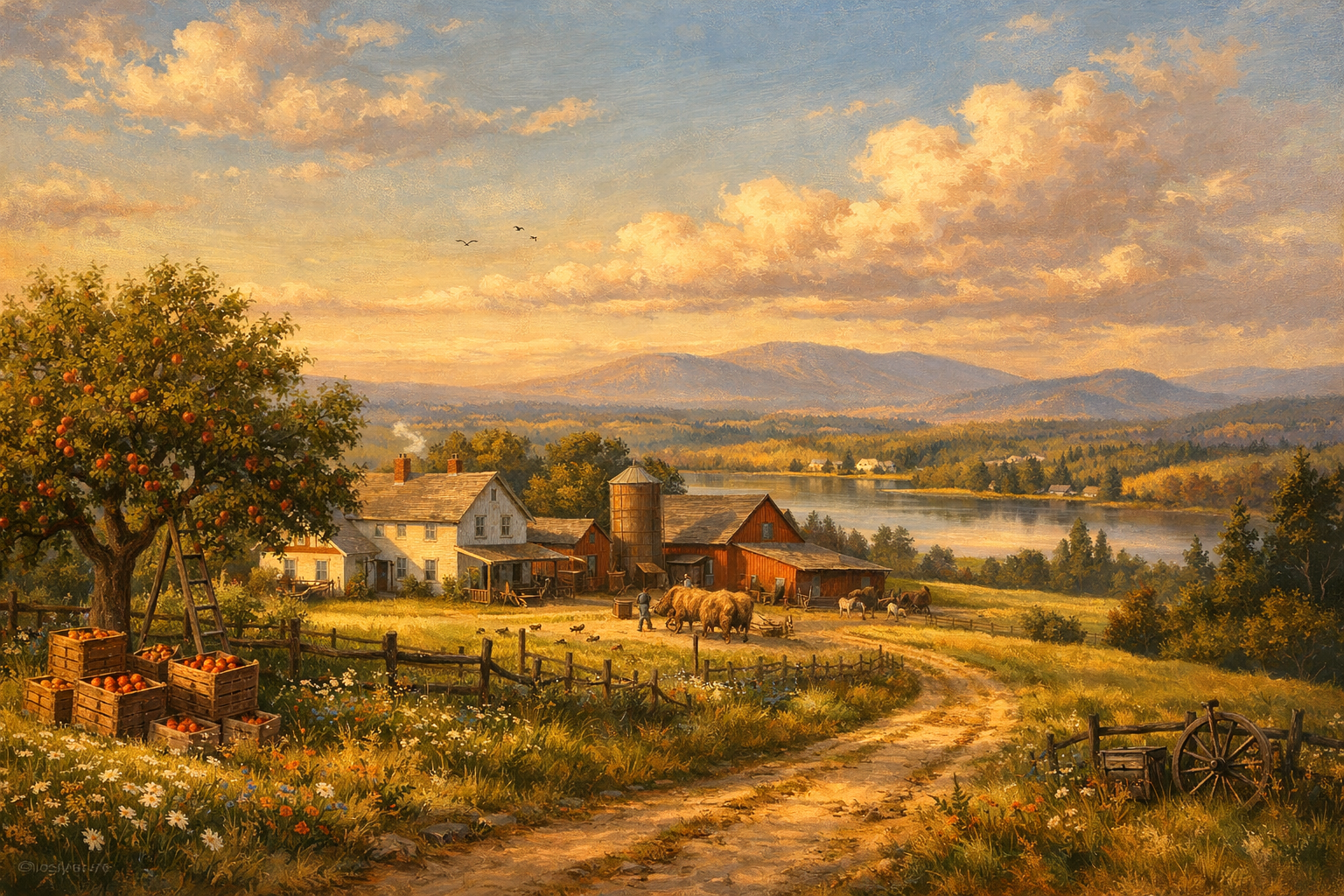
Then came his boldest venture. Harry set the entire Valley Farm into apple orchard, planting row upon row of Ben Davis trees. It was a calculated gamble. Ben Davis apples traveled well, maturing during the long sea voyage to England, where they fetched excellent prices. As the trees grew and began to bear, Harry could almost see the future he had worked toward.
But the world shifted beneath his feet. With the outbreak of World War I, shipments to England ceased. The market collapsed. The apples that were supposed to secure his family’s prosperity now had nowhere to go.
Harry still churned sixty pounds of butter a week, tended poultry, and raised vegetables in abundance. But even his best efforts could not bridge the financial gap. After the birth of Julian in October 1915, he knew he had to make a change.
The move to Hardscrabble Road in Poland seemed, at first, like a fresh start. The land looked promising—flat, open, and ready for cultivation. The house was comfortable, with room enough upstairs for the children as they grew. Auburn was only four miles away, offering schools, transportation, and the possibility of outside work. Harry could still sell produce in Lewiston. On paper, it was the perfect solution.
Reality proved harsher. The land was deceptive. Frosts lingered late in spring and returned early in fall. The soil drained poorly. Crops failed. And then came the worst blow: the loss of his team of horses in the Little Androscoggin River. For a man who loved his animals deeply, it was not only a financial disaster but a personal heartbreak.
Even with work in Auburn, the years on Hardscrabble Road were some of the hardest Harry ever faced.
After four long years, the family prepared to move once more. This time, five miles away on Harris Hill in Poland, they found what they had been searching for all along: a home that welcomed them, land that rewarded their labor, and a farm with possibilities as wide as the horizon.
On Harris Hill, the Goss family finally found the good life—earned through perseverance, loss, and the quiet courage of starting over again and again until they found the place that felt like home.