
Researched and Written By: Don Goss
Chapter I — The Croft at the Edge of the World
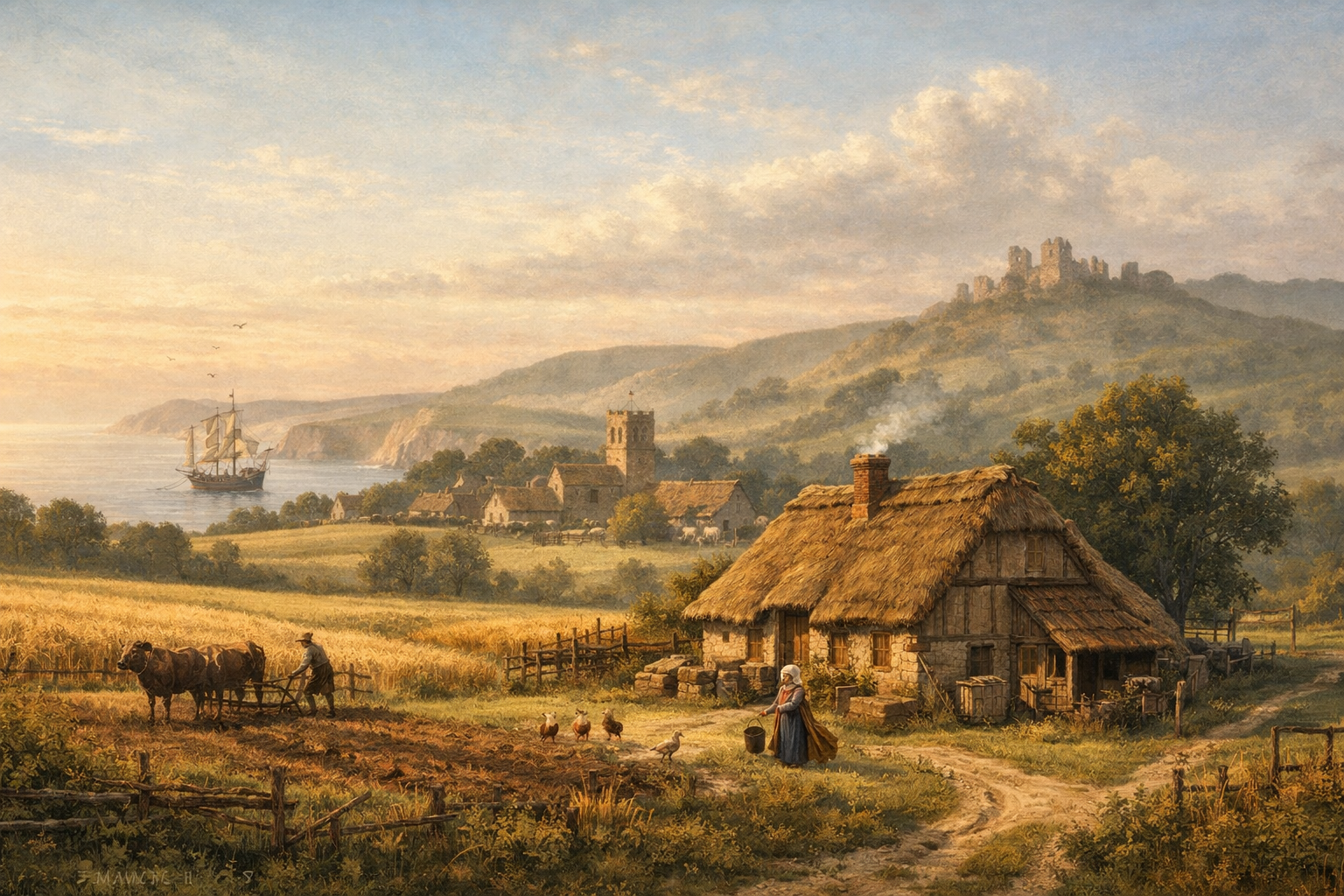
The dawn mist clung to the hills of Axminster like a veil, softening the edges of the world. At the center of that quiet landscape stood Gosseton Croft, a modest freeholding of barley fields, grazing meadow, and a strip of ancient woodland. To most, it was an unremarkable patch of earth. To Thomas Goss the Elder, it was a kingdom.
Thomas rose before the sun, as he always had. His father had survived the Great Mortality; Thomas had survived the famine that followed. Hardship had carved deep lines into his face, but it had also carved a fierce pride into his heart. The land was theirs — not rented, not borrowed, not held at the whim of a lord. The Goss name was tied to soil, and soil was life.
Inside the timber-framed house, Elyen Goss tended the hearth. She was the quiet force behind the family’s survival, the keeper of accounts, the negotiator of rents, the one who ensured the children learned their letters from the parish clerk. She believed knowledge was a kind of armor.
Their children — John, William, Agnes, and Robert — grew up in a world still haunted by plague but alive with possibility. None of them yet knew how far the century would carry them.
Chapter II — John Goss and the Gathering Storm
By the time John reached manhood, England was cracking along its seams. Whispers of discontent drifted through taverns and market squares. The houses of Lancaster and York circled each other like wolves.
John wanted no part of noble quarrels. He wanted only to tend the fields, raise his son, and keep the croft whole. But in 1455, a Yorkist lord rode through Axminster and demanded men for his levy. John was given no choice.
The march north was long and cold. John had never seen so many men gathered in one place as he did at St. Albans. When the battle erupted, it was chaos — screams, steel, the smell of blood and wet earth. John survived, but something inside him shifted. He returned home quieter, older, carrying memories he never spoke aloud.
His son would grow up watching him stare into the fire at night, lost in thoughts shaped by war.
Chapter III — William Goss and the Call of the Sea
Where John was rooted to the land, William was drawn to the horizon.
As a boy, he carved miniature boats from driftwood. As a young man, he apprenticed himself to a shipwright in Lyme Regis, a bustling port where the smell of tar and salt hung thick in the air.
William had a gift. He understood timber the way some men understood horses — how it bent, how it breathed, how it wanted to be shaped. His master trusted him with more responsibility each year, and soon William was designing hulls that could withstand the rough Atlantic swells.
By the 1470s, fishermen whispered that a Goss-built boat could ride out storms that would break lesser vessels. One such boat, it was said, reached as far as Icelandic waters.
William never saw Iceland himself, but he dreamed of it. He dreamed of lands beyond even that — places no Englishman had yet imagined.
Chapter IV — Agnes Goss and the Manor Court
Agnes Goss inherited her mother’s sharp mind and her father’s stubbornness. She married a reeve — a local official — and quickly became known as a woman who could argue a case better than most men.
When disputes arose over grazing rights or boundary stones, villagers sought her counsel. She stood before the manor court with her chin high, her voice steady, and her logic unassailable.
Once, a minor noble attempted to seize a strip of meadow from several families. Agnes confronted him in full view of the village. She did not shout. She simply laid out the facts, the charters, the customs — and stared him down until he relented.
Her children would inherit her fire. Her grandchildren would inherit her fearlessness.
Chapter V — The Last Winter of the Century
By 1499, the world had changed.
Thomas Goss the Elder had long been laid to rest in the churchyard, but his descendants were scattered across Devon and Dorset — farmers, carpenters, clerks, sailors. The croft still stood, weathered but sturdy, its hearth warm through the winter storms.
John’s son had grown into a thoughtful man, shaped by his father’s silence. William’s apprentices were building ships that ventured farther each year. Agnes’s influence still echoed in the manor court. Robert, the youngest, had become a steward on a noble estate, learning the ways of land and law.
The century had tested them. It had hardened them. It had taught them to read the tides — of politics, of weather, of opportunity.
And somewhere among the children of this sprawling family, perhaps in a boy listening to tales of ships and far-off lands, the first spark was lit — the spark that would one day carry the Goss name across the Atlantic.