
Researched and Written By: Don Goss
Chapter I. The Edge of England (c. 1550)
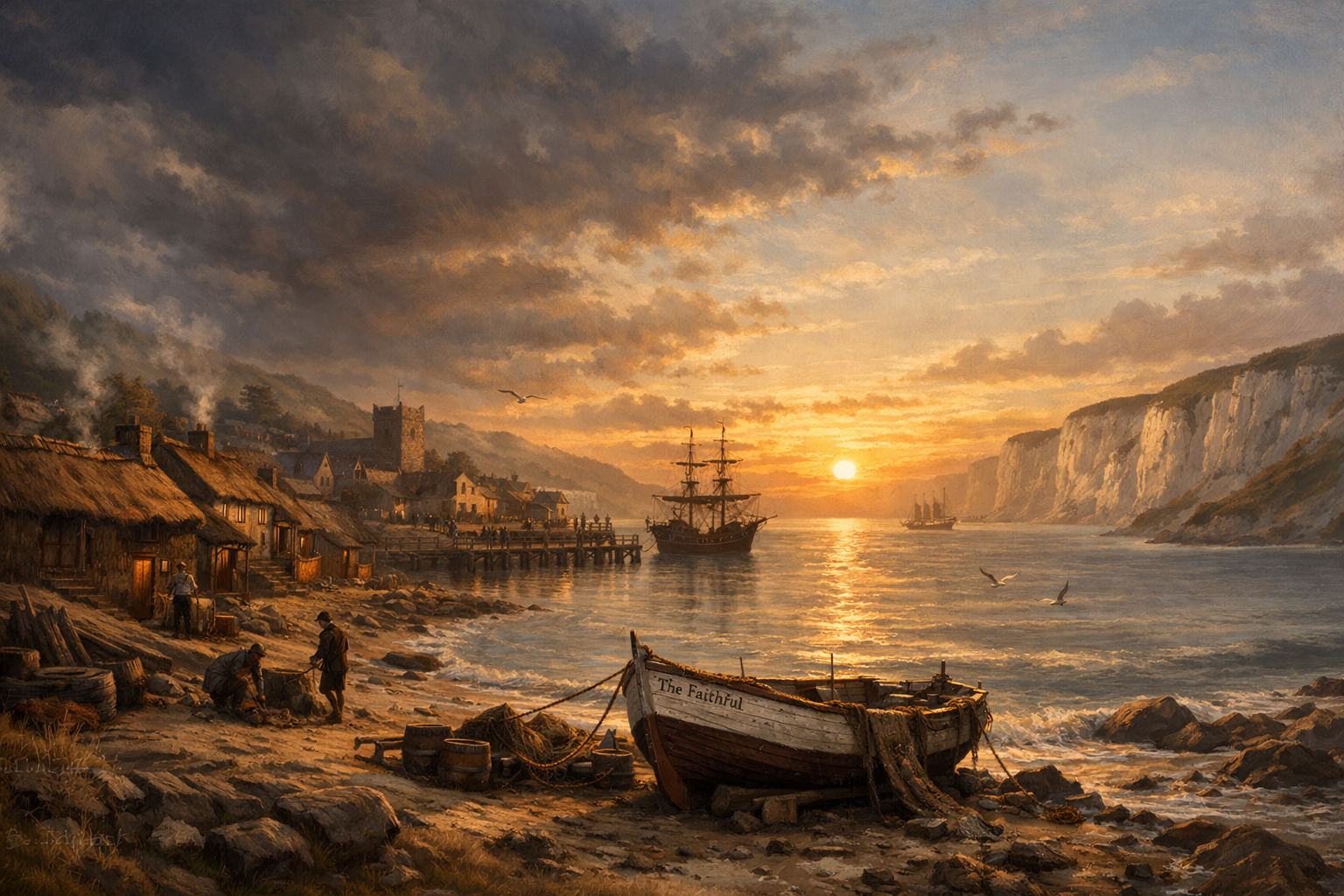
The wind came screaming off the Channel long before the storm clouds appeared. In the village of Charmouth, where the cliffs of Dorset rose like broken teeth above the sea, the Goss family had learned to read the weather the way monks read scripture.
Thomas Goss, broad‑shouldered and salt‑scarred, stood on the shingle beach with his son William, watching the horizon darken.
“Storm’s turning,” Thomas muttered. “Not a common one.”
William, barely twenty, tightened the rope around the bow of their small fishing boat. “We’ve seen worse.”
Thomas shook his head. “Not like this.”
The sea had been their life for generations. The Goss men were fishermen, boatwrights, and sometimes smugglers when the taxes grew too heavy. Their cottage sat close enough to the harbor that the waves could be heard even in sleep — a constant reminder that the sea gave and the sea took.
That night, it took more than it gave.
The storm struck with a violence that villagers would speak of for decades. Waves smashed boats against the harbor wall. The wind tore roofs from cottages. Lanterns blew out, leaving the village in darkness except for the flashes of lightning that illuminated the chaos.
Thomas and William fought to save their vessel, The Faithful, but the sea was merciless. They managed to drag it higher onto the shore, but many neighbors were not so fortunate. When dawn broke, the beach was littered with wreckage — and grief.
The Goss family opened their home to two widowed families, sharing their food, their fire, and their strength. It was the first recorded moment — though no one wrote it down — when the Goss name became synonymous with steadfastness.
Chapter II. A New Tide (1570s)
Thomas’s grandson, John Goss, grew up in the shadow of that storm. He inherited his grandfather’s hands — thick, capable, scarred — but not his contentment. John was restless.
He listened to sailors who returned from voyages to Newfoundland, speaking of waters so thick with cod that nets broke under their weight. He heard tales of forests across the ocean, of land unclaimed, of opportunity beyond anything England’s crowded coast could offer.
One evening, as the sun bled orange across the sea, John told his father:
“I want to sail farther than these waters.”
His father studied him for a long moment. “The sea beyond England is not kind.”
“Neither is the life here,” John replied.
And so, with a small bundle of clothes and a heart full of ambition, John signed onto a merchant vessel bound for the North Atlantic. He learned navigation, rigging, and the brutal discipline of long voyages. He returned home between trips with stories that made the younger Goss cousins stare wide‑eyed.
It was John who planted the first seed of migration in the family’s imagination.
Chapter III. The Children of John (1590–1620)
John married a woman from Lyme Regis — Margery, sharp‑tongued and warm‑hearted — and together they raised several children. Among them was Nicholas Goss, born around 1590, a boy who inherited his father’s curiosity and his mother’s stubbornness.
Nicholas grew up hearing stories of the New World. By the time he reached adulthood, England was changing again. Queen Elizabeth was gone. King James ruled. Religious tensions simmered. Land was scarce. Opportunity scarcer.
Nicholas married young and moved east along the coast, eventually settling near Marblehead, a rough fishing village north of Boston — not the American Boston, but the English one, a name that would later echo across the ocean.
Marblehead was a place of hard men and harder lives. The sea there was colder, the cliffs sharper, the winters cruel. But Nicholas thrived. He became known as a reliable fisherman, a man who could read the tides like a book.
And it was there, around 1662, that his son Richard Goss was born.
Chapter IV. The Birth of Richard (1662)
Richard entered the world during a time of upheaval. England had just endured civil war, the execution of a king, the rise of Cromwell, and the restoration of the monarchy. Even in Marblehead, far from London’s politics, the effects were felt.
Richard’s earliest memories were of the sea — the smell of tar, the creak of ropes, the shouts of fishermen hauling in their catch. He learned to walk on uneven ground, to balance on rocking boats, to tie knots before he could write his name.
But Richard was different from the generations before him.
He looked inland.
While his father and uncles were content with the life of fishermen, Richard felt the pull of something else — land, opportunity, the promise of a future not bound to the tides.
He listened to travelers who spoke of Maine, of the Pejepscot Claim, of forests untouched and rivers wide. He heard of settlers carving farms from wilderness, of communities forming in places where the old rules of England no longer applied.
And in that wild frontier, Richard saw possibility.
Chapter V. The Turning of the Tide (1680s)
By the time Richard reached adulthood, the world had changed again. The colonies in New England were growing. Ships crossed the Atlantic more frequently. Families who had once clung to the English coast now looked westward with hope instead of fear.
Richard married, gathered what little he owned, and made the journey north into the Maine frontier. The land was harsh, the winters brutal, but the soil was rich and the rivers full of promise.
He settled near the Androscoggin River, in the region that would become Danville, and later Auburn. There, he built a home, raised children, and planted the roots of the Danville Goss line.
The courage that had carried his ancestors through storms, through wars, through generations of hardship — that same courage carried Richard into the wilderness.
And from him came the family whose story you are now preserving.
Chapter VI. The Legacy
A century before Richard Goss set foot in Maine, his ancestors stood on the cliffs of Dorset, staring into storms that threatened to swallow their world. They survived by grit, by generosity, by stubborn hope.
Those qualities crossed the ocean long before the family did.
Richard did not know Thomas or William or John. But he carried their spirit — the resilience of fishermen, the curiosity of sailors, the quiet strength of people who lived at the mercy of the sea yet refused to bow to it.
The Danville Goss family was not born in Maine.
It was forged in England, in storms and saltwater, in hardship and hope, in the hearts of men and women who believed that life could always be made better for the next generation.
Richard was simply the first to step onto the path they had been preparing for a hundred years.