
Researched and Written By: Don Goss
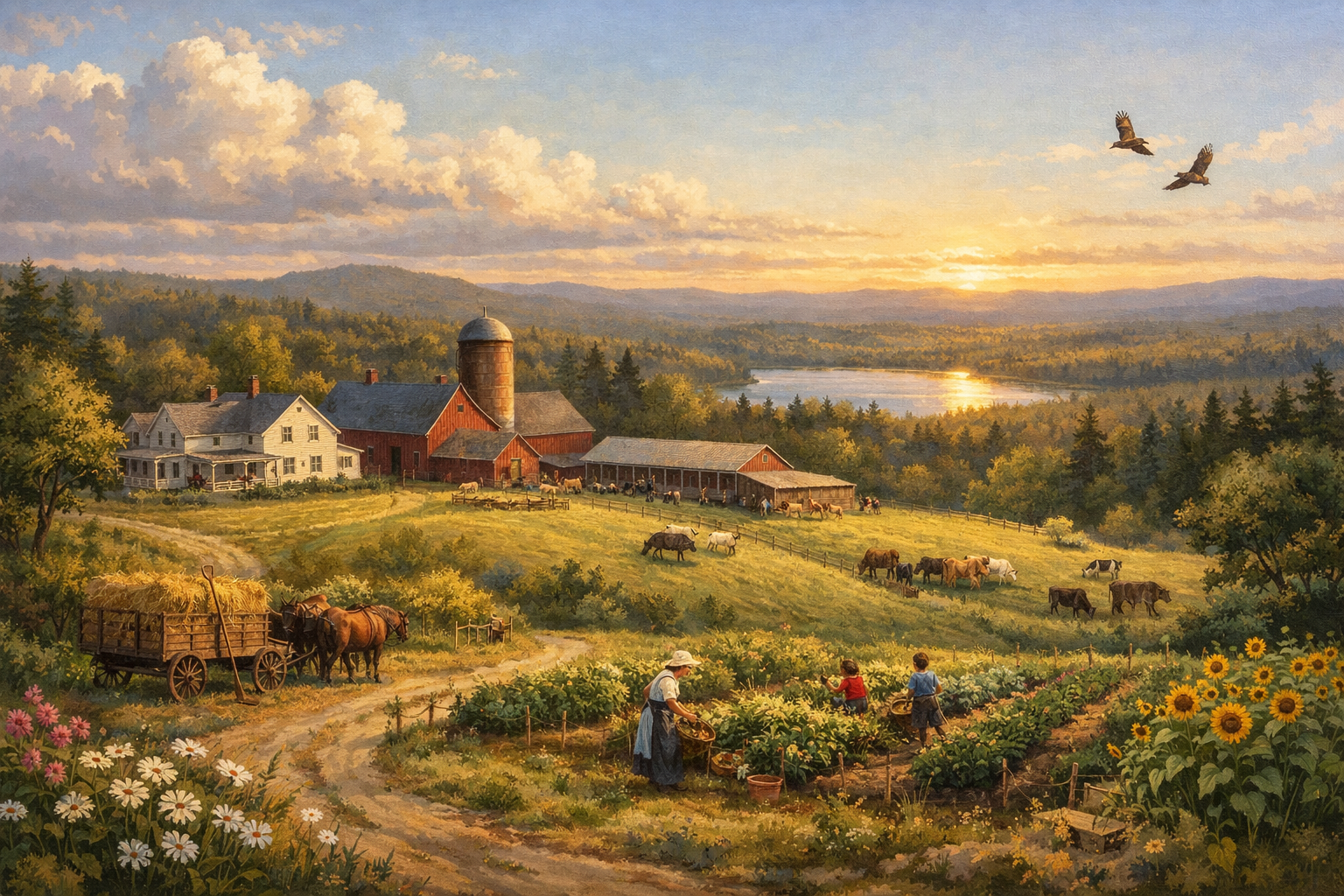
Harry Goss arrived on Harris Hill with the quiet confidence of a man who already knew the land, the seasons, and the rhythm of farm life. Farming wasn’t simply his trade; it was his calling. As the original text puts it, he believed it to be “one of life’s noblest callings” and he embraced it with joy. He brought with him not only livestock and tools, but generations of inherited knowledge—implements passed down, habits learned from fathers and grandfathers, and a deep sense of purpose.
The family settled quickly into the new homestead. The routines of Greene followed them to Poland: the early mornings, the steady churn of work, the weekly route to Lewiston and Auburn where loyal customers waited for butter, eggs, poultry, and garden produce. These customers were more than buyers—they were friends—and Harry knew that “this had to continue without interruption or the market would be lost.”
But Harris Hill demanded more. Nine mouths to feed, children growing, needs multiplying—expansion wasn’t optional. It was survival. And so the Goss farm grew, one project at a time, each described in the old stories: poultry, berries, dairy, gardens, woodlots, and the endless cycle of haying.
Despite the hardships, the family lived well. One schoolchild even declared that the Gosses were rich—his mother had said so. The truth was more modest. They had no luxury, but they had what mattered: warm clothes, good food, a comfortable home, and the quiet dignity of self‑reliance. As the document notes, “the farm paid for all the needs of the large family.” During the Depression, when others faltered, the Goss farm endured through diligence, thrift, and the ability to “make do.”
The Hen House and the Thieves
One of Harry’s first major projects was the hen house—a sprawling, four‑room structure built beyond the barns. It was a world unto itself, filled with the soft bustle of hens who, as one family member later recalled, seemed “happier than any group he had ever seen.” They laid faithfully, and their eggs fed both the family and the market.
But prosperity attracts thieves.
Foxes slipped from the woods, hawks swooped from the sky, and sometimes—worst of all—humans crept in under cover of darkness. One morning before market, Harry spotted a lantern flickering inside the henhouse. He ran toward it, but the thieves fled, leaving behind their bagged chickens. The culprit was suspected but never proven. The family never forgot these intrusions; the stories of Snuffy Smith were not funny to those who had lived the real thing.
The Poultry Enterprise
The poultry business became one of the farm’s most complex operations. Harry kept three breeds—Rhode Island Reds, Barred Rocks, and White Leghorns—each chosen for a purpose. Eggs went to Lewiston or to a Boston commission agent. Meat birds, including capons carefully prepared by William and Paul, were prized by luxury hotels like the Mansion House and Poland Spring House.
In the cellar, incubators glowed through the night. The Buckeye incubator, holding six hundred eggs, hummed with life. The kerosene lamp had to be watched constantly—“the flame must not go out.” When the chicks began peeping, the sound rose through the floorboards like spring frogs. Harry hatched his own chicks, hatched for others, and sold chicks to neighbors. His success came from relentless attention to detail; nothing was done halfway.
Berries and the Children’s Summer Work
In the 1920s, the family entered the berry business. It was grueling work, but profitable. Strawberries, raspberries, blackberries, blueberries—each had its season, its market, its stories.
Church youth helped pick strawberries under Ruby’s supervision. One girl, Iola Chase, set the record with fifty quarts in a day. The pickers earned three cents a quart, a welcome sum in those days.
Afternoons brought the selling rounds. Older brothers drove the wagon while younger ones knocked on doors in Mechanic Falls. They still laughed about the wealthy man at Minot Corner who refused to buy berries because he “still had rhubarb in his garden.” But most customers welcomed the fruit, and the boys earned two cents per quart sold.
The Dairy: Butter, Cows, and Chores
The dairy was the heart of the farm. Harry specialized in butter, not milk, and kept cows suited for rich cream—Jerseys and Guernseys. The boys remembered every cow by name and temperament. Some trades went well; others brought back troublemakers like the infamous Jezebel, who returned to the farm years after being traded away.
Milking was by hand. The separator hummed as Julian and Elwood, barely eight and nine, turned the handle at “sixty revolutions per minute.” Skim milk fed the calves; cream went to the churn. Twice a week, butter “came,” and Ruby molded it into one‑pound blocks, salted to each customer’s taste.
Chores were endless: carrying water from the well, feeding grain, hauling hay and ensilage, cleaning stalls, spreading manure. In winter, cows stayed in their stanchions; in summer, they grazed the rough pastures.
Beef, Pork, and the Hard Lessons of Farm Life
The Goss farm raised little beef, but enough for home use. Butchering was often hired out—Harry loved his animals too much to do it himself. One son never forgot the day his beloved bull Dewey was felled by the butcher’s axe. The grief was real, as the text says, “as if it had been some other of his teenage friends.”
Pigs, usually named Josephus, were easier to part with. One day, while Harry was away, the teenage boys butchered a hog using only an Extension Department manual. They followed each step carefully, and by the time Harry returned, the job was done to perfection.
Haying: The Backbreaking Season
Haying defined summer. Before tractors and balers, everything depended on horses and muscle. The mowing machine rattled across the fields until a rock snapped the pitman rod—sending Julian and Elwood trudging three miles to Perley Yeaton’s blacksmith shop.
Hay dried in the sun, was raked into windrows, forked onto wagons, and hauled to the barn. There, the great hay fork swung from the rafters, hoisting loads into the lofts. Older brothers shouted for the younger ones to stow it faster. The little boys sweated and swore they would never be farmers.
The Garden and Ruby’s Labor
The garden fed the family year‑round. Potatoes—“a bushel a week”—were eaten three times a day. Beans simmered overnight for Saturday and Sunday meals. Squash, peas, carrots, cucumbers, tomatoes, pumpkins, rutabagas, parsnips—Ruby canned hundreds of quarts each year, using two‑quart jars because her family always finished them.
She worked beside Harry in planting, weeding, hoeing, and harvesting, even when the garden was moved to distant fields for crop rotation. Yet she still found time for flowers: dahlias, roses, lilacs, syringa. Her shrubs became living memorials, blooming long after she was gone.
Fuel, Woodlots, and Winter Work
Wood was the farm’s lifeblood. Harry cut fifteen cords a year, often in deep snow, leaving stumps three feet high. Logs were hauled out by sled, sawed by Millard Lane’s rig, split, stacked, dried, and carried into the house daily. The kitchen stove burned constantly except in summer, when the kerosene stove took over.
Electricity arrived in 1924, but the Goss family declined it—cash was too scarce.
Plowing and Cultivating
The land was rocky, stubborn, and unforgiving. After every plowing, stones had to be hauled away. Equipment broke often. The plowboy guided the horse while the steel blade turned the earth. Harrows—disc and spring‑tooth—smoothed the soil. After planting, weeds were fought by hoe and cultivator. It was backbreaking work, but it was the foundation of everything the farm produced.