
Researched and Written By: Don Goss
James F. Goss lived out his final years on the Goss farm, a quiet presence whose shadow stretched long across the family’s memory. He died in 1917, only seven weeks after little Elwood was born. Ruby would later say, with a mixture of sympathy and honesty, that her father‑in‑law loved all the children—except the newborn whose cries pierced the sickroom and the failing strength of an old soldier.
But to Harold, James was a companion of rare closeness. The two spent hours together, the old man spinning stories while the boy listened with wide‑eyed devotion. Most of those stories came from the war—James’s war—the one that had shaped him long before he ever set foot on the Goss farm.
He had been twenty‑four when he enlisted in Company B of the Ninth Maine Volunteers. Five feet four and a half inches tall, auburn‑haired, and wearing a size‑five boot, he marched off on September 22, 1861, for a three‑year enlistment that would mark him for life. His first major posting was Fernandina, Florida, where the humid air carried malaria straight into his bloodstream. It never left him.
From there he went to Hilton Head, South Carolina, serving nearly a year before joining General Grant’s brutal 1864 campaign toward Richmond. The fighting was savage—some of the worst ever recorded—and somewhere along that march, crossing a river bridge under a punishing sun, James collapsed with sunstroke. He was hospitalized and, on September 27, medically discharged.
The war had taken its toll: a foot injured by a dropped barrel of beans, curvature of the spine, chronic emphysema, and the ever‑present malaria. His pension was four dollars a month until 1896, when it was raised to ten.
After the war he married Sarah Martin, but the political bitterness of the era seeped into their home. They divorced, and she lived out her days single in Hackett’s Mills. James remarried on December 31, 1868, to Sarah T. Ross, and for twenty years he worked the Ross place before drifting—Auburn, then Greene, and finally back to Poland to live with his son Harry.
James was more than a farmer. He was a master butcher, known across the region for his skill in slaughtering and preserving meat. Farmers sought him out, and he traveled widely to help with what was then one of the most essential tasks of rural life.
When age finally overtook him, Harry took over the farm and cared for his father with devotion until the end.
Faith
Faith, the eldest, arrived on December 30, 1907, and grew up in the thick of Harry’s early farming years—the Hardscrabble days. She attended the country school, then the Harris Hill school, graduating from Poland’s eighth grade in 1921 alongside Dorothy Pulsifer, who would one day marry into the family.
Her high‑school path had been decided long before: Edward Little High School in Auburn. The move to Harris Hill complicated things, but Faith—steady, willing, and adaptable—made it work. She boarded with families in Auburn and Danville, helping with chores in exchange for room and board, riding the Interurban Electric to school when she lived with Ruby’s parents.
She excelled in commercial studies and even represented her school in a statewide typing competition in Bangor. After graduation she taught school briefly, then moved to Easton, Massachusetts, to live with her uncle J. Elmore Goss while studying business in Boston. In 1928 she married, closing her chapter as a daily member of the Goss household.
Harold
Harold was the quintessential big brother—mechanically gifted, endlessly curious, and the first of Harry’s true “right‑hand men.” He built gates, repaired machines, and could explain the workings of a water pump with the patience of a seasoned teacher.
For eighth grade he transferred to the Mechanic Falls village school, riding each day behind Winkers, a nearly thirty‑year‑old horse driven by the stern but reliable neighbor‑teacher next door.
As a teenager he worked summers as a bellboy at Ricker Inn at Poland Spring, earning $75 in tips his first year and $150 the next. After graduating in 1928 he became a bookkeeper at Meserve Lumber Company. Marriage came two years later, and though he no longer lived under Harry’s roof, he settled on a neighboring farm, remaining deeply intertwined with the family’s daily life.
William
William—“Will”—would one day become the most proper and dependable of the Goss children, but his early years told a different story.
There was the Sunday he slipped out unnoticed and sat smiling in the middle of the dirt road, shifting sides each time a neighbor tried to maneuver her horse around him. There was the day in the barn loft when Paul fell—or was pushed—through the great hay door to the hard ground below. And there were the times he climbed onto the barn roof to shout at passersby while Ruby frantically sought help.
Yet beneath the mischief, Will was steady. At twelve he was trusted to drive the team and mowing machine a mile to Robinson’s field. In high school he joined the Drama Club, traveling to perform in various towns. After graduation he worked several jobs, eventually buying the farm from his parents—only to sell it to Julian when he realized farming wasn’t his calling. He moved back in with his parents and cared for them faithfully in their later years.
Paul
Paul, two years younger than Will, was his equal rather than his follower. Together with Harold, they were “the big boys,” while the younger brothers formed “the little boys.” Paul often bridged the gap—sometimes leading the younger ones, sometimes joining the older ones in serious work.
He was bright, book‑loving, and naturally skilled. He and Will took special interest in the poultry business, and Paul became indispensable during haying season. His high‑school class was unusually close‑knit, and his classmates remembered him as excellent in his studies and “full of fun and joy.”
He graduated in 1931, worked various jobs—some with Will—and at twenty bought a farm, married, and began his own household.
Julian
Tall, thin, gentle Julian was the quiet heart of the family. He never complained, never shirked, and seemed content in every task. Harry had a special fondness for him, calling him “Pa’s Dooner,” a nonsense name spoken with affection.
Julian helped his mother constantly—cooking, cleaning, and managing household tasks—while also working the fields, watering cattle, hoeing, and plowing. When the older boys left home, Julian became the primary errand‑runner and marketer, his friendly nature earning him many friends.
He dreamed of becoming a chef. After graduating in 1933 he worked at Poland Spring and other resorts, but before his marriage he gave up the culinary path and bought the home farm. In 1940 he married and stepped into the role of its new master.
Elwood
Elwood was too young for heavy farm work until 1927, when he announced he wanted to learn to milk. Ruby asked if he meant it—really meant it—and when he said yes, she set him to it. That summer marked the beginning of seven years in the dairy, where he learned feeding formulas, ration planning, and the rhythms of milking, watering, and cleaning.
He disliked poultry work and dreaded the endless rows of strawberries he and Julian hoed, but he loved school and devoured his father’s library, especially history. After graduating in 1934, he spent a mosquito‑ridden summer chopping wood in the swamp, saving $90 before leaving Maine to pursue his education.
Ara
Ara, the youngest, carved out his own place in the long line of Goss boys. He graduated in 1936, worked hard on the farm, and seemed to enjoy the garden work more than most. Ruby had a special tenderness for him—he was considerate, helpful, and attentive to her needs.
After high school he helped his grandparents in their final years, worked at the State School in Pownal, a diner in Lewiston, and the Shipyard. In 1943 he entered the army, closing the chapter of his daily life on the Goss farm.
Dolly and Ponto
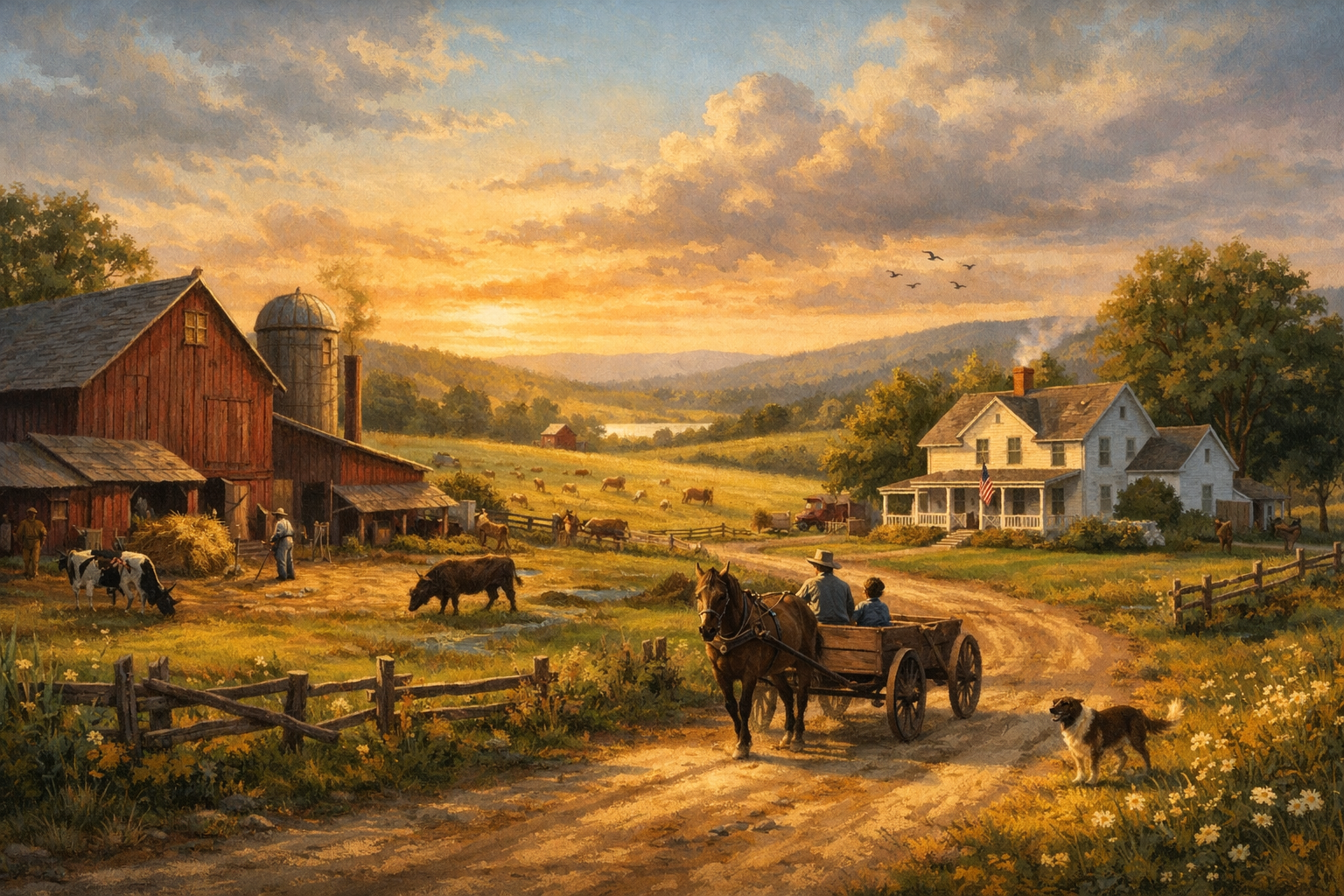
The Goss farm was never without animals, but two stood above the rest.
Ponto, the loyal dog, was Ara’s guardian in his earliest years. He could be sent alone to fetch the cows from distant pasture, rounding up even the stragglers and bringing them home with quiet authority.
Dolly, the black horse, was the family’s treasure—swift, gentle, and wise. Harry trusted her so completely that he often dozed on the ride home from market, knowing she would navigate the road safely. She worked in perfect partnership with Laddie, the blind, stubborn horse who supplied strength while Dolly supplied the brains.
Her death was a heartbreak. One evening she fell violently ill, rolling and groaning while the family kept vigil. Hours later she died, likely of colic. Millard Lane came with his team and drag to help bury her in the back pasture, refusing payment. “It was hard enough to lose such a good horse,” he said.
To this day, family members think of her whenever they pass the sandbank where she rests.