
Researched and Written By: Don Goss
The Goss farm was never a quiet place—not in the years when Harry and Ruby’s boys were small. Life there moved with the rhythm of chores and seasons, but beneath it all ran a current of laughter, mischief, and the kind of joy that only a Maine farm could give.
In those early years, the children learned quickly that fun and responsibility were not opposites but companions. They were expected to work, yes—but they were also expected to live, and the farm gave them a world to explore. As one brother later remembered, the woods, the fields, the sandbanks, the snow-covered hills “were all filled with joy” .
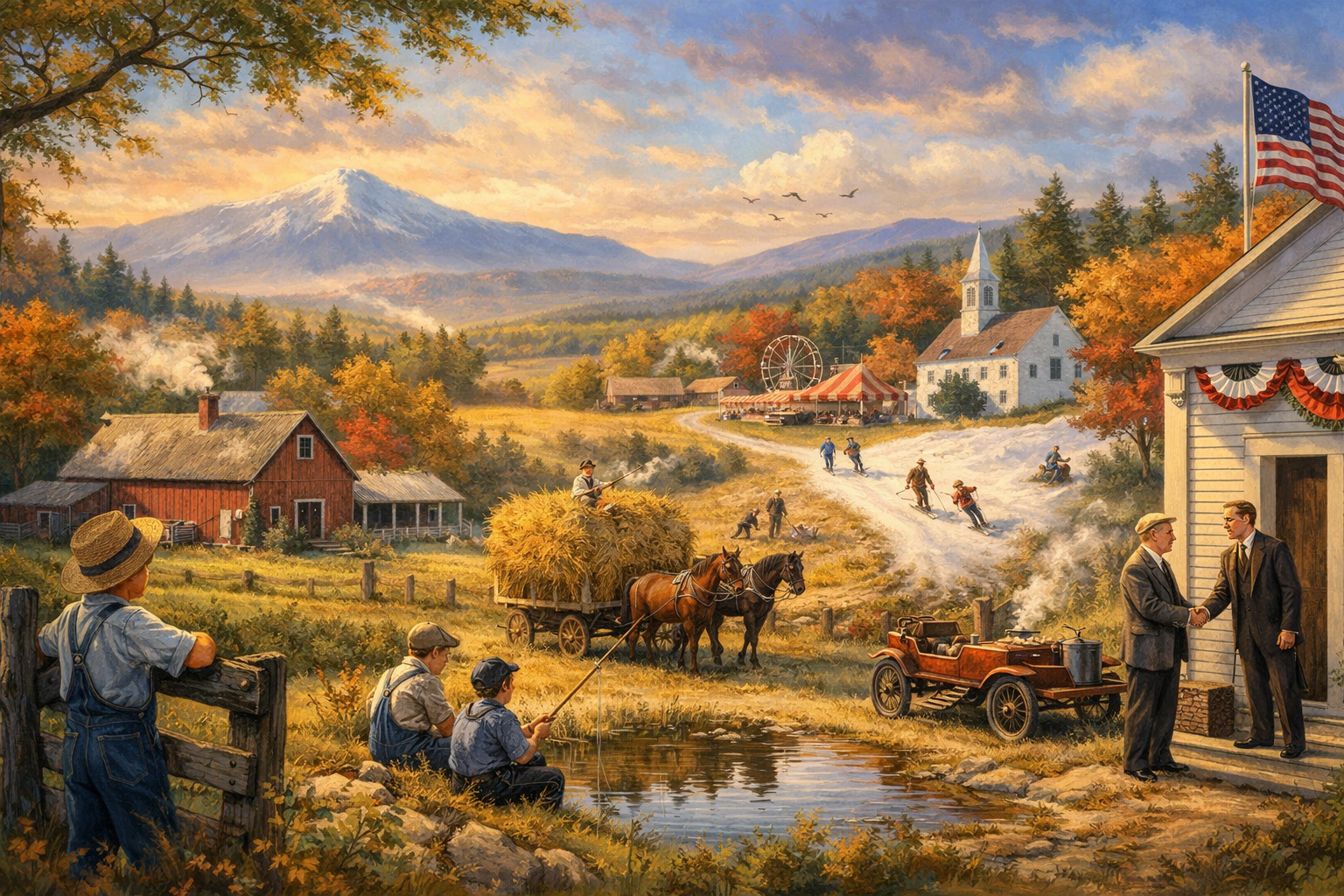
Winter nights were their kingdom. Under a bright moon, the hills behind the house became silver slides, and the boys—bundled, breathless, unstoppable—raced down them on skis bought for thirty‑five cents at the little store at Poland Corner Station. The skis were crude things, hardly more than planks, but they carried the boys into years of adventure. “I think that they were Pa’s most rewarding investment,” one brother said, “for by spending that little he gave countless hours of sustained pleasure to each of us for many years” .
Summer brought a different kind of excitement. There was hay to bring in, fields to tend, and animals to care for—but there were also rare outings that shone in memory. A Farmer’s Field Day in West Bath, for instance, where Harold watched a man cook clams on the boiler of a Stanley Steamer. The State Fair in Lewiston was another highlight, full of noise and color. The boys still laughed about the huckster who barked, “If you have a good time you got to spend money. If you spend money you go home broke” .
And then there was the day they climbed Mount Washington—wind, rain, and all. A miserable day by most standards, but to the Goss boys it became a badge of honor.
When winter returned, the family gathered around the table for games—parcheesi, flinch, checkers, and whatever else could be played by lamplight. One night, Harry himself joined in. He stepped forward with a broomstick, cleared his throat, and performed a mysterious sequence of motions. “You can do a little,” he teased, “but you can’t do this.” One by one the children tried and failed, until finally one brother caught the trick: the clearing of the throat was the first step. Simple fun, but the kind that stays with a family for generations.
School events, church socials, dramas, ball games, picnics—these filled the spaces between work and worship. The children grew up surrounded by community, by laughter, and by the sense that life, even when hard, was meant to be enjoyed.
Church Relationships
Faith was not an accessory in the Goss household—it was a foundation. When Harry and Ruby married, they made a deliberate choice: they would build their life within the church. Ruby had long wished to be baptized “in accordance with the Baptist mode,” and in 1911, she and Harry entered the waters of Lake Sabattus together, joining the Greene Baptist Church .
From that moment, Harry’s quiet abilities became responsibilities. He soon found himself serving as deacon, church clerk, and Sunday School Superintendent. He took special pride in writing the letter that invited the local Free Baptist Church to unite with Greene’s congregation—a step that helped form the United Baptist Church of Greene.
When the family moved to Poland, they first attended the small Marston’s Corner Church, but it was the Pleasant Street Baptist Church that captured their hearts. Harry drove the team there one Sunday morning, and the family knew instantly that they had found their spiritual home. One by one, the boys followed their parents into the baptismal waters—Harold and William first, then Paul, Julian, and Elwood in 1927, and finally Ara .
The church became an extension of the Goss household. Friends like Bertha Waldron, John and Flossie Sellers, the Pearls, and the Maxims helped shape the boys’ Christian character. Over time, the Goss family’s service multiplied across generations. By 1992, Harry and Ruby’s six sons and their wives had collectively served more than eight hundred years in Baptist churches, with more than fifty descendants active in the same congregation .
Faith, for the Goss family, was not merely inherited—it was lived.
The Grange
Community life extended beyond the church. Harry and Ruby were devoted Grangers, first in Androscoggin Grange in Greene and later in Excelsior Grange in Poland. The Grange Hall stood only half a mile from their home on Harris Hill, and its warm lights and familiar voices became part of the weekly rhythm.
Saturday evenings were meeting nights—except in winter, when two of those Saturdays became all‑day gatherings. Members arrived in the morning, shared a hearty dinner at noon, and stayed for an afternoon session filled with business, culture, and entertainment. Ruby often oversaw the meals, ensuring that the tables were laden with food that brought comfort and pride to the community.
Excelsior Grange was once so large that two long horse sheds had to be built to accommodate the teams. Nearly every family in the area belonged, some for the insurance benefits, but the Goss family for the fellowship. Harry loved the Grange’s informality—how everyone was on a first‑name basis, how neighbors became friends, and how dignity and good humor shaped every gathering .
All but one of the Goss children eventually joined as well. The Grange was not just an organization—it was a second home.
The Extension Service
Life on the farm was always evolving, and Harry and Ruby embraced the modernizing influence of the Farm Bureau and the Government Extension Service. Harry built his large henhouse according to the “Orono Plan,” the latest in agricultural design. Ruby attended Home Demonstration meetings at the Grange Hall, where local women learned new methods for cooking, clothing, and home management.
The older boys joined the Four‑H Club, learning skills that shaped their futures—cooking, clothing, communication, and farm projects. Ruby served as a project leader, guiding the young people with the same steady warmth she brought to her own home .
Politics
Politics ran deep in the Goss family, shaped by the legacy of the Civil War. Harry’s father had been a volunteer soldier, and his mother’s brother had also fought. The ideals of that conflict—unity, sacrifice, and national purpose—were woven into the family’s identity.
When Harry came of age, Theodore Roosevelt dominated the national stage. Roosevelt’s vigor and plainspoken strength captured Harry’s loyalty, and the Goss household grew up admiring the man who “walked softly and carried a big stick” .
Harry believed in choosing the best man for the job—but he also believed that the best man was usually found in his own party. His opinions were respected, and his reputation carried weight.
That reputation helped his eldest son, Harold, when he entered politics. Still in his twenties, Harold ran for the Legislature, representing Poland, Greene, and Wales. His success was his own, but the memory of Harry Goss in Greene earned him an almost unanimous vote there. Even in Poland, where his opponents were seasoned public servants, Harry’s good name opened doors. In one memorable moment, Harold’s father‑in‑law persuaded the Robinson sisters—who had never voted in their lives—to cast ballots, but only if Harry himself asked them. He did, and they agreed. Their votes, small as they were, helped secure Harold’s overwhelming victory .
Politics, like faith and farming, became another thread in the tapestry of the Goss family story.