Written by Don Goss 32° KCCH / Eminent Grand Warder Grand Commandery of Knights Templar of the State of Florida
The higher Degrees in Freemasonry are intriguing to me as they expand upon the Hiramic Legend in the Master Mason Degree. While some authors argue that true Masonry includes only the Entered Apprentice, Fellow Craft, Master Mason, and occasionally the Royal Arch, dismissing everything beyond as unnecessary, I disagree. I believe these other Degrees have always been a crucial part of Freemasonry and should be respected and supported as they contribute to the entire fraternity.
Let’s clarify a few terms. Freemasonry was an established institution in the British Isles, with its origins tracing back to around 1390. This period marks the publication of the Regius Poem, essentially the bylaws of a guild trade association. Organized Freemasonry likely predates this by only a few decades, certainly no earlier than 1300. I completely dismiss theories involving the Knights Templar, ancient mysteries, and other similar concepts. I am convinced that Freemasonry began as a trade guild or labor union and later evolved into a men’s fraternity in the eighteenth-century.
In the late 1590s, William Shaw, the King’s Master Mason in Scotland, ordered lodges to start keeping minutes, marking the first records of individual Masonic lodges. By around 1390, we have bylaws from the freemasons’ trade association. About two hundred years later, lodges began recording minutes.
The oldest lodge minutes belong to the now-extinct Lodge of Aitchison’s and Haven in Scotland. On January 9th, Robert Widderspoon became a “fellow of the craft,” choosing George Aytone and Johne Pedded as his instructors. He paid a fee of twenty shillings and gave gloves to each Master. While gloves are no longer presented, we still maintain the fee and instructors. This record dates back to 1598.
The following year, there are comprehensive minutes from Edinburgh Lodge number one, which still meets today. These early records reveal that Brother George Patroon was reprimanded for hiring a cowan, an untrained Mason, to work on a chimney. A cowan may be skilled but isn’t part of the guild or Lodge. This highlights the Lodge acting as a labor organization, enforcing the use of its members for jobs.
At this stage, Freemasonry functions mainly as a trade association with minimal speculative elements. It involves basic moral teachings using working tools, like squaring actions by virtue or controlling passions with compasses. Freemasonry now has two degrees: Entered Apprentice and Fellow Craft. There were two types of Masters: the “Master of the Lodge,” an elected presiding officer, and the Master Mason, who was a lodge member responsible for a job site. The role of Master Mason could shift among members depending on who won the work contract, making it a temporary administrative position.
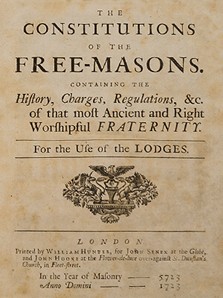
In 1717, the first Grand Lodge was established in London. Unlike Scotland, where local Lodges were sufficient, London saw a surge in gentlemen Masons likely due to the Great Fire of 1666, which necessitated city reconstruction and ended the London Company of Masons’ monopoly on stonework. By 1717, the organization shifted towards being more speculative, admitting honorary members as it lost its royal monopoly. The newly formed Grand Lodge had two degrees: Apprentice and Fellow Craft, similar to those in Scotland. James Anderson’s 1723 publication, “Constitutions of the Free Masons,” also mentions only these two degrees. Though there are hints of a third ceremony from the late 1600s, concrete evidence only appears in 1725.
At a Philo Musicae et Architecturae Societas meeting, you could see that Charles Cotton and Papillon Ball were regularly elevated to Master, and brother Geminiani achieved Fellow Craft and Master. This instance in 1725 marks the first higher degree in Freemasonry, which builds on previous degrees by extending the legends and adding a new level of membership.
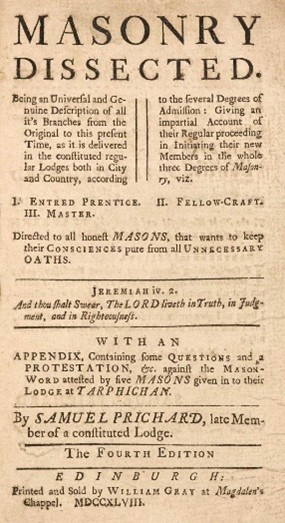
In 1725, higher Degrees were introduced to Freemasonry, and the Grand Lodge accepted them without disturbance. The Master Mason’s degree was quickly integrated into their structure. By 1730, solid evidence of new degrees appeared with the publication of “Masonry Dissected,” an elaborate exposé revealing the secrets and ceremonies of Freemasonry, including Enter Apprentice, Fellow Craft, and Master Mason degrees.
“Masonry Dissected” gained tremendous popularity; it sold out multiple editions within days of its first advertisement on October 22, 1730. By November 3rd, a pirated edition emerged due to high demand. Harry Carr noted this surge in interest because Freemasonry was growing and there was a lack of printed guidance for new Master Mason ceremonies.
The Master Masons degree emerged in 1725, with no prior written records of its existence in Freemasonry. Although there are hints of an earlier presence, it is officially recorded in 1725. By 1733, Rollinson’s List of Lodges mentioned Lodge number 115 in London as a “Scotch Mason’s Lodge,” which was unusual compared to other lodges listed either as unspecified or as Master Masons lodges. In 1734, Pines’ list reaffirmed number 115 as a Scotts Mason’s Lodge. In 1735, at the Lodge at the Bear pub in Bath, minutes revealed a Lodge of Masters conducted a different ceremony for admitting Scott’s Master Masons.
In 1717, the Grand Lodge was established, and by 1723, the Freemasons’ Constitutions were introduced, although the two-degree system was still in use. By 1725, the Master Mason’s degree emerged in militant manuscripts. In 1730, a comprehensive exposé was published in Pritchard’s “Masonry Dissected,” and three years later, evidence of a new degree, the Scots Master’s degree, began to surface. While we lack specific records of the Scots Mason’s Degrees at this point, it is clear that significant developments were occurring.
In 1737, just four years after the first mention of the Scots Masons Lodge, Michael Andrew Ramsey delivers his famous oration in Paris, known as Ramsey’s oration. This speech is significant for introducing a new ritual thread into Freemasonry by claiming, without evidence, that the Craft originated with the Crusades. At a time when chivalry and knightly history were highly popular, Ramsey’s idea would soon gain traction.
In 1738, a year after Ramsey’s speech, the Irish Lodge in Lisbon was ordered to cease meetings by its Worshipful Master following a papal bull against Freemasonry. Despite this, the Inquisition questioned the Master. Notably, Hugo O’Kelly mentioned “Excellent Masons” and “Grand Masons,” terms whose exact meanings are unclear—whether they refer to higher lodge officers or distinct degrees remains uncertain. However, it is evident that by 1738, the Inquisition was informed of other Mason classes.
In 1740, at Old Lodge number 1 (now Lodge Antiquity number 2 in London), 9 members were made Scots Master Masons. That same year, the Lodge in Bristol decided that Master Masons could become Scots Masters. This was significant because it established that one must be a Master Mason before becoming a Scots Master. This happened just fifteen years after the first written mention of the Master Mason Degree, solidifying the requirement to be a Master Mason before advancing to Scots Master.
It is quite thrilling that we have preserved minutes from a Berlin lodge dating back to 1742. The mere existence of these records is remarkable. During World War II, the Nazis seized the records of the Grand Orient de France and transported them to Berlin. When the Russians captured Berlin, they took these Nazi records back to Russia. It was only in recent decades that these records were returned to the Grand Orient de France, revealing the presence of a Scottish lodge in Berlin in 1742. We now have minutes from this Scottish lodge, although their activities remain largely unknown, suggesting they were engaged in something beyond the Master Mason degree.
Furthermore, in 1742, a curious newspaper account describes a parade in Dublin, which might be the earliest evidence of the Royal Arch degree. The report is vague, stating: “fourthly the Royal Arch carried by two Excellent Masons. Fifthly, the Master with all his proper implements.” The meaning of carrying the Royal Arch is unclear—whether it refers to a replica of the Ark of the Covenant or Noah’s Ark. In French, ‘arch’ can mean both an arch and a boat. It’s possible they were carrying a model of either Ark, or perhaps two deacons held staffs forming an arch with ribbons, under which the master walked. This might, just possibly, be the first mention of the Royal Arch degree.
In 1743, records show the Royal Order of Scotland, then known as the Scotch Herodom of Kilwinning, holding a meeting in London. That same year, Baron von Hund claimed he was initiated into a branch of Masonry by masked men, who revealed to him that Freemasonry descended from the Knights Templar. This branch, known as the Strict Observance, spread through Europe, with members strictly following the secretive instructions of unknown superiors. Thus, the Templar tradition became part of Freemasonry, adding more layers to its history just 28 years after the first Grand Lodge’s formation.
In 1743, France sees a significant development in freemasonry with the emergence of Scottish Masters, or Maîtres Ecossaise. These members claim special privileges at Lodge meetings, such as not removing their hats, keeping their swords, and remaining seated when others stand. A provincial Lodge reports this to the Grand Lodge, seeking guidance.
In 1744 France, “Le Franc Meissen” discussed Maîtres Ecossaise, the fourth degree of Masonry. Evidence from that time suggests the Royal Arch degree existed. Meanwhile, in York, England, Fifield D’Assigny noted a specific Master Masons assembly known as Royal Arch Masons, which likely gave rise to the term “York Rite.” That same year, France saw the publication of “La Parfait Masson,” hinting at the Scots Mason Degree and describing the Maîtres Ecossaise’ focus on rebuilding Solomon’s Temple, led by Zerubbabel—an enduring theme in York Rite Freemasonry.
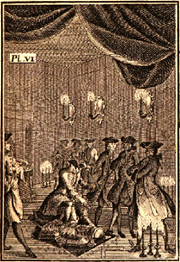
In 1745, the broken seal references Crusader princes blending with the myth of rebuilding the temple. “The Order the Freemasons Betrayed” from 1745 discusses Ecossaise Masons of a higher Degree. By 1750, there’s more evidence of the Royal Order of Scotland.
By 1752, there is strong evidence that the Royal Arch degree was practiced in England. A scam in London involved men called Leg of Mutton Masons, who would confer a degree in exchange for a mutton dinner. These fraudsters were examined by the Grand Lodge of Ancients, who found they had no knowledge of the Royal Arch degree. This shows that the Grand Lodge of Ancients valued the Royal Arch degree enough to investigate these con artists.
The following year holds significant importance in Royal Arch Masonry. The first recorded instance of the Royal Arch degree being conferred was in 1753, just 28 years after the initial Master Mason degree conferral in 1725. This historic event took place in Fredericksburg, Virginia, and not in London, Ireland, Paris, or Edinburgh. Three men were raised to the Royal Arch Mason degree, marking its established presence in Masonry from 1753 onward.
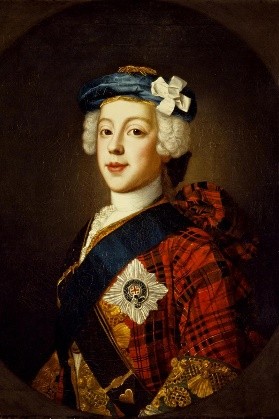
Something curious occurs in England: discussions on the Royal Arch degree begin just as chatter about the Scots Master’s degree fades away. It’s like Scots Masters Lodges vanish and Royal Arch lodges suddenly appear. What caused this shift? In 1745, Bonnie Prince Charlie returned to Scotland, raised an army, and attempted to reclaim the throne for the Stewarts. As the Catholic pretender, he was defeated at the Battle of Culloden, after which he fled to France, never to be seen again. Post-1745, it became politically incorrect to be Scottish in England, with Scots viewed as disloyal to the Crown. This led to a potential transformation where Scottish lodges might have rebranded themselves as Royal Arch lodges, retaining core elements while changing their names—a plausible theory, though not confirmed.
In 1761, a significant event occurred in the development of higher degrees Freemasonry. Stephen Morin, a French wine merchant from Bordeaux, immigrated to the Caribbean to start a business. The Emperors of the East and West, possibly a separate organization or members of the Grand Lodge of France using a different name, issued a patent to Morin to establish Perfect and Sublime Masonry globally. Perfect Masonry refers to the Degrees conferred in the Lodge of Perfection, while Sublime Degrees include those above it, such as the Princes of Jerusalem, Knights Rose Croix, and Knights of Kadosh.
In 1763, Morin arrives in Santo Domingo. While we know he was authorized to spread Perfect and Sublime Masonry, we aren’t sure what degrees this included at that time. In that same year, the first successful exposé of Freemasonry, “The Most Secret Mysteries of the High Degrees of Freemasonry Unveiled,” was published, detailing a seven-degree system. These degrees are remarkably similar to present-day Scottish Rite Degrees, though some are quite different or recognizable only as parts of current ceremonies. This occurred just as Morin arrived in the Caribbean.
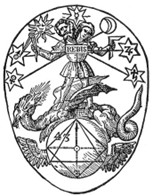
In 1763, Stephen Morin established a new organization called The Order of the Royal Secret, also known as the Rite of Perfection. The question remains whether this 25-degree system was something he brought from France, given to him by the Emperors of the East and West, or if he created it himself from existing elements. It’s possible he used parts of Le Plus Secret for his new work, but there’s strong suspicion that Morin was the main force behind its creation.
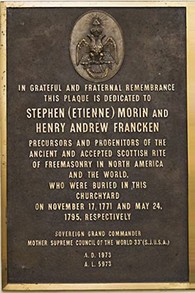
Between 1763 and 1767, Morin appointed Henry Andrew Franken, a Dutch merchant based in Albany who traded goods between New York and the Caribbean. We know Morin arrived in the Caribbean in 1763, and Franken established a Lodge of Perfection in Albany in 1767, so they met sometime within those years. Franken’s significant contribution was transcribing Royal Secret rituals into at least four books, creating the earliest English-language version of higher Degrees of Freemasonry. By 1769, two years after the Albany lodge’s founding, we have the first evidence of a Knights Templar order being conferred, noted in official meeting minutes. The Knights Templar first appeared in minute books in the United States, specifically at Saint Andrews Royal Arch Lodge, known for its members like Paul Revere, Joseph Warren, and John Hancock, and their role in the Boston Tea Party from the Green Dragon Tavern.
In 1801, the Supreme Council of the Scottish Rite was established in Charleston, expanding Stephen Morin’s 25-degree Order of the Royal Secret by adding eight more degrees. This new high-degree system addressed organizational weaknesses. Interestingly, while the Royal Arch first appeared in Fredericksburg, Virginia, and the Knights Templar in Boston, the Supreme Council of the Scottish Rite began in Charleston. Freemasonry’s reaction to these sophisticated, well-organized higher degree systems was acceptable, as long as they didn’t cause disruptions.
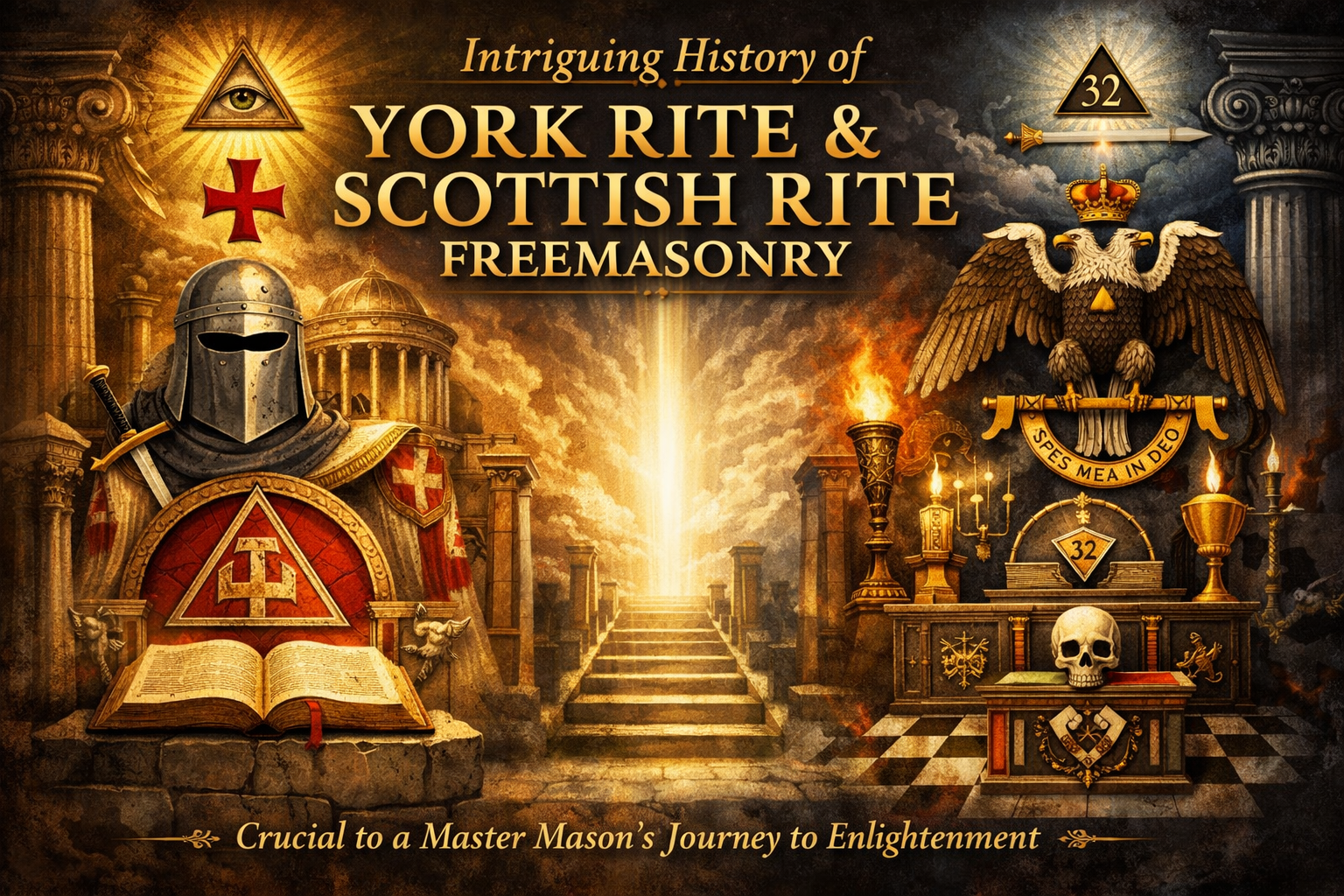
York Rite and Scottish Rite are deeply rooted in Masonic history, expanding on the Hiramic Legend and other teachings. In addition, York Rite includes invitation-only bodies preserving degrees no longer practiced such as Allied Masonic Degrees, York Rite College, & Knight Masons. These higher degrees are crucial for a Mason’s journey to enlightenment.
Freemasonry includes various appendant bodies and degrees, enhancing its attractiveness by inviting members to delve into diverse Masonic traditions. Here, we provide a brief overview of the modern Scottish and York Rites of Freemasonry.
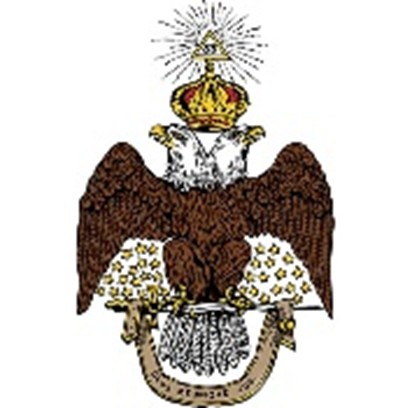
The Ancient and Accepted Scottish Rite — Despite its name, The Ancient and Accepted Scottish Rite is neither ancient nor from Scotland. Recognized by the United Grand Lodge of England as a concordant body of Masonry, its allegories and rituals largely focus on the construction of King Solomon’s Temple in Jerusalem.
The Scottish Rite is comprised of 33 degrees that are controlled by various Masonic bodies. By completing these additional degrees, Masons are afforded the opportunity to engage further with Masonic philosophy and build upon the ethical principles introduced within the three core degrees of Blue Lodge Freemasonry.
The York Rite of Freemasonry — similar to the Ancient Accepted Scottish Rite in name—can be somewhat misleading. It is actually a collective term describing three interconnected branches: Royal Arch Masonry, Cryptic Masonry, and the Knights Templar. Through the York Rite, members have the opportunity to attain ten additional Masonic degrees.
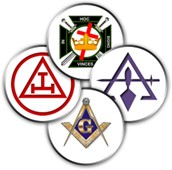
nlike the Scottish Rite, each York Rite body provides distinct perspectives on Freemasonry tailored to specific faiths. For example, the Knights Templar focuses on the valorous knights who protected pilgrims during the Crusades and is suited for Christian Masons.
At its core, becoming part of either the Scottish or York Rite in Freemasonry offers a chance to deepen your understanding of the Craft. You will encounter new teachings and allegories not covered in the three primary degrees, enriching your overall Masonic experience.
While not for everyone, completing the additional rites is something that many brothers aspire to, and is another element that makes Freemasonry so unique and varied.
A Master Mason looking to broaden their Masonic connections, and understanding would gain from participating in both Scottish Rite and York Rite Freemasonry.
What distinguishes the Scottish Rite from the York Rite in extended Masonry? An unrestricted answer would quickly become overwhelmed with details. For instance, there are hundreds of differences in each Body’s rituals.
To better inform a Blue Lodge Freemason contemplating the further pursuit of Masonic Light, it’s essential to step back from the specifics and illustrate the broader context. My viewpoint comes from having served in most local positions within the two organizations, though without any state or national roles.
Firstly, it’s crucial to highlight the primary similarities. Both groups are Masonic entities committed to societal betterment by enhancing individual character. Through moral teachings and camaraderie, they encourage conduct that refines individuals and fortifies communities. This aligns with the Blue Lodge principles, which instruct a man on being an improved husband, father, son, neighbor, congregant, and citizen.
The primary difference between the two organizations lies in their core objectives. Scottish Rite Masonry advocates for individual freedoms and the rights and responsibilities of citizenship. In contrast, York Rite Masonry, particularly in its final Degrees or Orders, champions Christianity. To become a Knight Templar Freemason within the York Rite, one must pledge to defend Christianity. However, individuals of other faiths (such as Judaism, Islam, Hinduism, etc.) who believe in a Deity are welcome to join Scottish Rite Masonry. Scottish Rite Masons are encouraged to actively lead in promoting and safeguarding individual rights: democratic governance, freedom of speech and press, fair treatment under the law, freedom of religion and individual autonomy, and the separation of church and state.
York Rite Freemasonry consists of three independent bodies: Chapter, Council, and Commandery. Each body holds rituals and meetings, with officer roles similar to those in the Blue Lodge but titled differently. The leading officers are called Excellent High Priest, Illustrious Master, and Eminent Commander, respectively. Members are addressed as Companion in the Chapter and Council, and Sir Knight in the Commandery.
Scottish Rite Masonry includes four coordinating Bodies: Lodge of Perfection, Chapter of Rose Croix, Council of Kadosh, and Consistory. The Lodge of Perfection handles the business activities for all four Bodies of the Scottish Rite. The highest-ranking officers in these Bodies are formally titled Venerable Master, Wise Master, Commander, and Master of Kadosh, respectively.
Most Blue Lodges don’t use costumes, but the Scottish and York Rites focus on theatrical presentations with intricate costumes, props, and staged backdrops to enhance their moral lessons. These performances are usually carried out by experienced actors rather than current Lodge officers.
Another noticeable difference from Blue Lodge is the attire sometimes worn by the ordinary members. Most striking of these are the uniforms worn by York Rite Commandery, complete with ceremonial swords. The uniforms are reminiscent of what was worn on formal occasions by naval officers a century ago. The chief characteristic is a large, folded-brim hat, called a chapeau, with ostrich plumes. The other two York Rite Bodies sometimes use modern blazer jackets, red for Chapter and purple for Council.
Scottish Rite allows nonritual attire limited to a pillbox hat. Most 32° Masons wear black hats with a double-headed eagle and gold braiding. Knights Commander of the Court of Honor (32° K.C.C.H. Masons) have red hats. The prestigious 33° Inspector General Honorary Masons wear rare white hats, while the very few 33° Active Members of The Supreme Council don purple or magenta hats.
Both Rites are involved in charity. York Rite Masons supports the Royal Arch Masons Auditory Research Assistance Program, the Council supports Cryptic Masons Medical Research Foundation, and the Knights Templar Eye Foundation for vision aid, and a Holy Land Pilgrimage for interfaith ministers. Scottish Rite Freemasons back 122 Childhood Learning Disorders Clinics and hospitals in Dallas and Atlanta for children with disabilities. They also perform local charity work and sponsor educational scholarships.
The governance frameworks between the two also vary. The Scottish Rite employs a hierarchical system that requires members to pledge loyalty to the Order’s national leaders, while the York Rite maintains a democratic governance structure at the State level.
Ultimately, both groups exemplify the principles of Brotherly Love, Relief, and Truth, much like Blue Lodge Masons.
In summary, a Master Mason looking for more light or further enlightenment should become a member of both the Scottish and York Rites to gain from the comprehensive teachings they have to offer.