
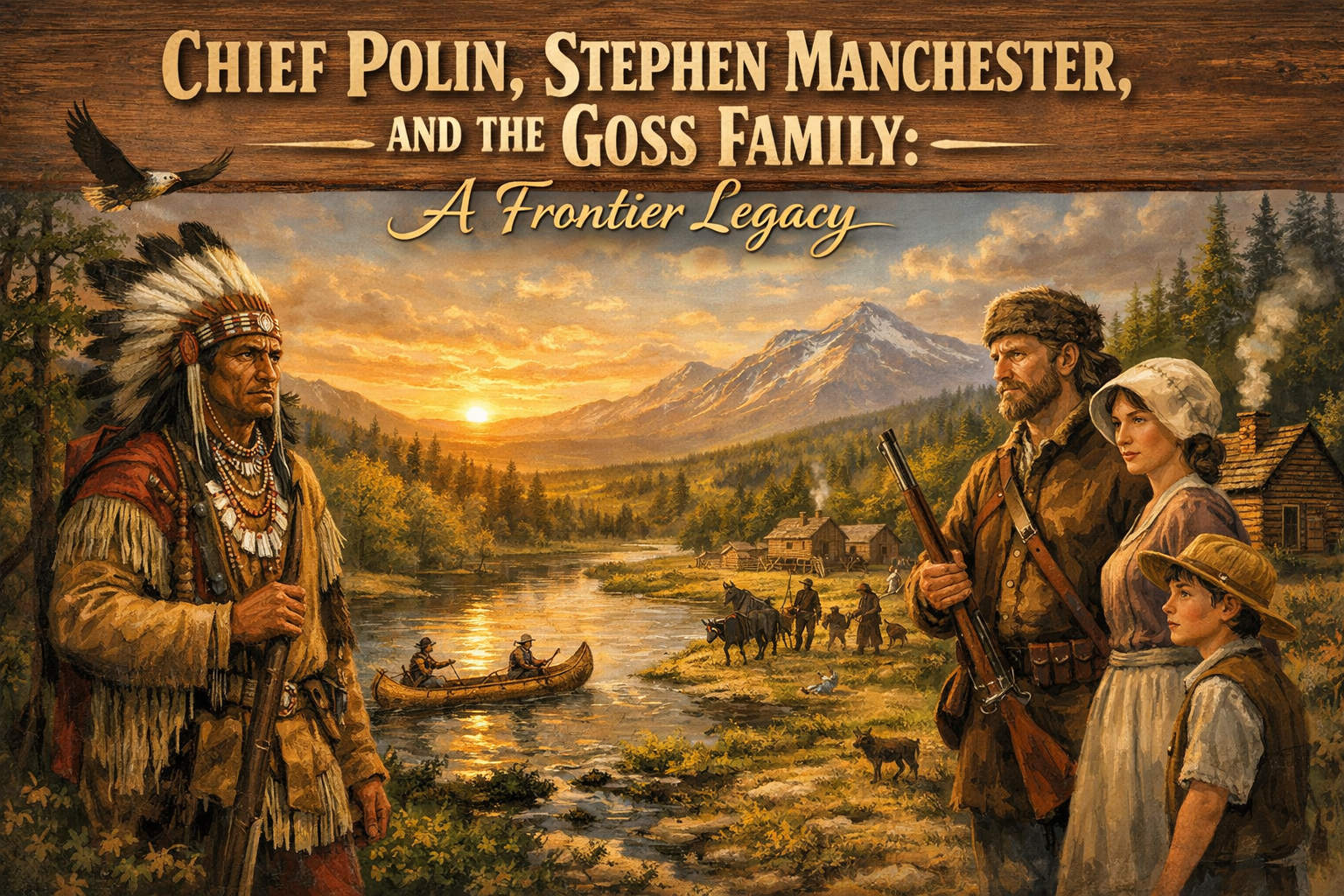
Researched and Written By: Don Goss
Chief Poland, also referred to as Polin, was a distinguished Native American leader in the mid-eighteenth century. He held the position of King within the Rockemekas lineage of the Abenaki tribe.
Similar to many Native Americans of the region, he traveled throughout southwestern Maine and was regarded by settlers as a courageous individual, accomplished hunter, and formidable competitor. Stephen Manchester, an English scout and frontier leader from Windham, frequently engaged with him in hunting and fishing competitions. Both individuals were recognized for their imposing stature and considerable strength.
As the third and last French and Indian War approached, settlers observed Chief Poland standing up for his people’s rights to land on both banks of the Presumpscot River. Although English colonists occupied the area, Native Americans maintained their claim as the land’s original owners.
Several Native American sub-tribes selected Chief Poland to represent their interests and convey their demands. He traveled to meet with Governor Shirley in Boston; however, he returned with news that the governor had declined their requests. Following this development, the Native Americans resolved to prepare for armed conflict.
The settlers in Windham recognized the imminent threat and sought to reinforce their defenses by constructing stockades capable of withstanding potential Native American attacks. This undertaking was complicated by the concurrent demands of the planting season. On May 14th, 1756, a small group—primarily comprised of older boys—was assigned to both reconnaissance and the tasks of building a gateway and planting corn. As Native Americans traversed the nearby river and became aware of the settlers’ presence, an attack ensued, resulting in casualties. Following the engagement, a combat unit led by Stephen Manchester pursued the Native American group.
History records only the settlers’ perspectives. According to one account, Chief Poland was cornered and forced to listen to Manchester’s speech about Native American treachery before being shot. However, it is unlikely that these respected leaders would act in such a manner. What we know for sure is that Manchester eventually gained the upper hand and killed Poland.
The Native Americans recovered the remains of their late leader and interred him beneath a young beech tree near Sebago Lake, intending for the burial site to remain concealed. Subsequently, they ended their involvement in the conflict and joined the Pequawkets in Fryeburg. The event is described in Whittier’s poem, “Funeral Tree of the Sokokis,” which details Poland’s burial.
Taken from the newspaper ” The Oracle” April 11, 1900
It is known that there was a chief among the copper-colored tribes called, Poland, and many have the impression that the town of Poland was named for a chief. This is not so but a brief sketch of his life may prove interesting.
Historians have few details about him, other than the fact that he led several tribes and played a significant role in the French and Indian War. According to tradition, he was a courageous warrior known for his speed, marksmanship, and unwavering hostility toward the white settlers.
He possessed the leading characteristics of his race, treachery and bravery, united perhaps with more than ordinary sagacity; but, notwithstanding his bravery he seemed to be afraid of Manchester, the scout the two being personally acquainted by what circumstances they became so we have no means of knowing. One fact remains certain, that Poland was very unwilling to meet the scout in a personal encounter. Both were stalwart men, both use to hardships; and both skilled in every artifice pertaining to Indian warfare.
One day while hunting in the woods of Falmouth, Manchester and Poland, unexpectedly met face to face. The old scout, ever on the watch and perhaps never quite forgetful of the fact that foes might be lurking near, was not to be taken unawares, and the two brave men stood facing each other with their leveled rifles. The wily Indian quailed before the fierce gaze of Manchester, who was ready and eager for action, and raising his hand begged for a parley.
“Manchester” said the great chief spoke in broken English, “me know you well. You big hunter and big brave. Me big hunter and big brave. You no shoot me, me no shoot you”.
Manchester, well knowing the treacherous nature of Poland, merely bowed his head in token of acquiescence and passed quietly on.
When several roads away Manchester stepped behind a tree, at the same time impaling his hat upon his ramrod and holding it out in full sight of the retreating chief. Poland walked on a few paces then suddenly turning sent a bullet straight through the hat, which he supposed must contain the head of its owner.
To the utter dismay of the Indian, who expected to see his most implacable foe struggling to his death agony, Manchester gave a shout of exultation and hastily approaching the would-be assassin to within a few feet pointed his rifle straight at his heart, and addressed him as follows, “You vile, contemptible dog of an Indian! Your time has come, you thought to murder me, but I knew you well enough to upset your little game. I am going to do the earth a favor by removing from her face a cowardly brute that has long shown himself unfit to live upon it. Hold up your hands.”
Poland threw his empty rifle upon the ground and raising his hands in obedience to the command, stood silent and sullen, not deigning a word in reply. Manchester took deliberate aim and pulled the trigger. The unerring bullet sped on its errand of death. Piercing the heart of the savage, who fell without a struggle or a groan, and Poland the Indian chief, lay dead.
There are other traditions concerning this chief. But as stated before, very little is known regarding his life.
The Descendants of Chief Poland and Stephen Manchester
Stephen Manchester, the hero of the Windham battle during the French and Native American War, had descendants, including Estella Thurlow. Chief Poland, the opposing warrior, also had a family. Although unverified, it’s believed his family was dispersed among white families. On September 16, 1773, John Poland married Judith Alley in Falmouth (Portland). It’s speculated that John was the Chief’s son.
There are no written or oral records of who brought up Poland’s daughter. Her name remains unknown. Sarah Ann Elwell, her granddaughter, recounted her story to Will and Stell’s daughters.
Chief Poland’s daughter lived with her unnamed husband at Sabbathday Lake, New Gloucester. He was a soldier in the Revolution. Their daughter, Betsey Elwell, married Jeremiah Elwell of Turner. Their daughter, Sarah Ann Elwell, was born in Fryeburg in 1821.
Sarah Elwell’s son, William Edwards, Junior, married Estella Thurlow on July 21, 1878. This marriage connected the legacies of two brave men who fought together for their homes and country. Their contributions played a significant role in shaping America, and they deserve recognition. The descendants of Will and Stell rightfully take pride in these warrior ancestors.
Preserving the Memories
Inez Edwards McPherson, who lived past ninety, had a sharp mind and a strong interest in her family’s descendants and ancestors. In her later years, after her sisters had passed, she shared her memories with her nephews and nieces, asking them to help preserve her grandmother’s family’s story.
Throughout the years, she recalled the tales familiar to her and her sisters. She vividly remembered the specifics of the Native American battle in Windham and her great grandmother’s challenging experiences as a “half Native American.”
Since then, the family has researched various sources to gather more information. They have discovered that records are difficult to locate. They have documented what they know here. Additionally, they hold ideas and opinions on many other relationships and events, which they will not record at this time. However, they will continue their research, and perhaps one day, someone will publish a more comprehensive account of the challenges and generosity the Native American children encountered after their warrior father’s death.
Today’s children in the family are typically around “1/128 Native American” compared to Will’s “1/8,” but they should take pride in their heritage and appreciate everyone who has played a part in it.
Chief Polin and the Presumpscot Resistance
Chief Polin, leader of the Abenaki people in southern Maine, was a fierce defender of his people’s rights to the Presumpscot River. As settlers dammed the river for mills, they disrupted salmon runs vital to the Abenaki diet and culture. Polin made multiple diplomatic appeals to Massachusetts authorities, even traveling to Boston in 1739. When diplomacy failed, he turned to armed resistance.
The 1756 Windham Raid
On May 14, 1756, Polin led a raid on the settlement of New Marblehead (now Windham, Maine). As settlers escorted Ezra Brown to his field, they were ambushed. Polin fired at Abraham Anderson but missed. Stephen Manchester, who had vowed to kill Polin, returned fire and fatally shot the chief. This marked the end of major indigenous resistance in the area.
Stephen Manchester: Patriot and Pioneer
Born in 1717 in Rhode Island, Manchester moved to Windham and became a prominent settler. He served in the Revolutionary War and was known for his bravery and leadership. His killing of Polin was seen as a pivotal moment in securing the settlement. He died in 1807 and is buried in Smith-Anderson Cemetery.
The Goss Family Connection
The Goss family were early settlers in Windham and knew the Manchesters. Land records and community ties suggest they were part of the same frontier network. Intermarriage and shared defense efforts bound these families together.
Legacy and Reflection
The death of Chief Polin symbolizes the tragic collision of indigenous sovereignty and colonial expansion. For families like the Gosses and Manchesters, it marked the beginning of a new chapter—one built on contested ground.
The Descendants of Chief Poland and Stephen Manchester
The old stories say that on the smoky field at Windham, during the French and Indian War, two warriors fought on opposite sides yet were bound by the same fierce devotion to their homeland. One was Stephen Manchester, remembered in local lore as the White Warrior of Windham. The other was Chief Polin, the proud Abenaki leader who defended his people with unyielding resolve.
Both men survived that violent chapter of frontier history, and both carried their families forward into the uncertain years that followed.
From Stephen Manchester’s line came many descendants, among them a young woman named Estella Thurlow. Her family knew well the stories of courage and sacrifice that had shaped their bloodline.
Chief Polin’s story took a quieter, more mysterious path. Tradition whispers that after the fighting ended, his children were scattered among white families—taken in, adopted, or absorbed into the communities that had once been their enemies. The records are thin, the memories blurred by time, but one name emerges from the shadows: John Poland, married in Falmouth (now Portland) on September 16, 1773, to Judith Alley. Many believed—though none could prove—that he was the Chief’s son.
Of Chief Polin’s daughter, history is even more silent. No written record preserves her name, and no family Bible carries her birth. What we know comes from the voice of her granddaughter, Sarah Ann Elwell, who told the tale to the daughters of Will and Stell many years later.
According to Sarah, Chief Polin’s daughter grew to womanhood at Sabbathday Lake in New Gloucester. She married a man whose name has been lost to time, a soldier who fought in the Revolution. Their daughter, Betsey Elwell, later married Jeremiah Elwell of Turner, and from that union came Sarah Ann herself, born in Fryeburg in 1821.
Generations later, the two lines—one descending from Stephen Manchester, the other from Chief Polin—met again. On July 21, 1878, Sarah Elwell’s son, William Edwards Jr., married Estella Thurlow. In that moment, the families of two frontier warriors—men who had once stood on opposite sides of battle—were united in peace.
Their descendants, the children of Will and Stell, inherited not only the mingled blood of these ancestors but also the legacy of their courage. Both warriors, in their own ways, helped shape the early story of America. Their struggles, sacrifices, and steadfast devotion to home and family deserve to be remembered by all who carry their names forward.
And so the lines of Manchester and Polin, once divided by war, now stand together in the living memory of their descendants—proud heirs to a shared and remarkable past.
Preserving the Memories
In her later years, when her hair had turned silver and her steps had grown slow, Inez Edwards McPherson remained as sharp‑minded as ever. She lived past ninety, but age never dimmed her curiosity or her devotion to the family whose stories she carried. Long after her sisters had passed on, she became the last keeper of their shared memories—the living bridge between the world of Will and Stell and the generations that followed.
In quiet conversations with nieces and nephews, she would sit with her hands folded and her eyes bright, recalling the tales she had heard as a girl. She urged them to remember, to write, to preserve what she could no longer safeguard alone. Above all, she asked them to keep alive the story of her grandmother’s people.
Across the decades, Inez had held fast to the stories she and her sisters once whispered to each other. She knew the old account of the Indian battle at Windham as if she had stood on the field herself. And she carried, with a kind of fierce tenderness, the memory of her great‑grandmother’s struggles—growing up as a “half‑Indian” woman in a world that did not always welcome her.
After Inez was gone, the family took up her charge. They searched records, followed rumors, and sifted through every scrap of history they could find. But the trail was thin. Many documents had vanished; others had never existed at all. What they have gathered here is what can be known with certainty. Beyond that, there are theories, possibilities, and family traditions—threads they have chosen, for now, to leave unwoven until more evidence appears.
Perhaps someday someone will uncover the fuller story: the hardships and the unexpected kindnesses that shaped the lives of the Indian children after the death of their warrior father. Perhaps the silence of the past will loosen, and the missing pieces will fall into place.
Today, the newest children of the family carry only a trace—“one‑hundred‑and‑twenty‑eighth Indian,” compared to Will’s “one‑eighth.” But the fraction is not the point. What matters is the inheritance: the courage, the resilience, the mingled histories of all who came before. And in that, every descendant has reason to stand tall.
They are part of a story worth remembering.