Researched and Written By: Don Goss
The name Goss is old—older than memory in some places—and it has wandered across continents the way rivers wander across a map. You can find it in many countries, carried by families who share no blood with one another, each with their own tale of how the name first came to them. In America, too, the name arrived in many separate streams. Some Goss families came from distant homelands, others from nearby towns, and most had no connection beyond the coincidence of a shared surname.
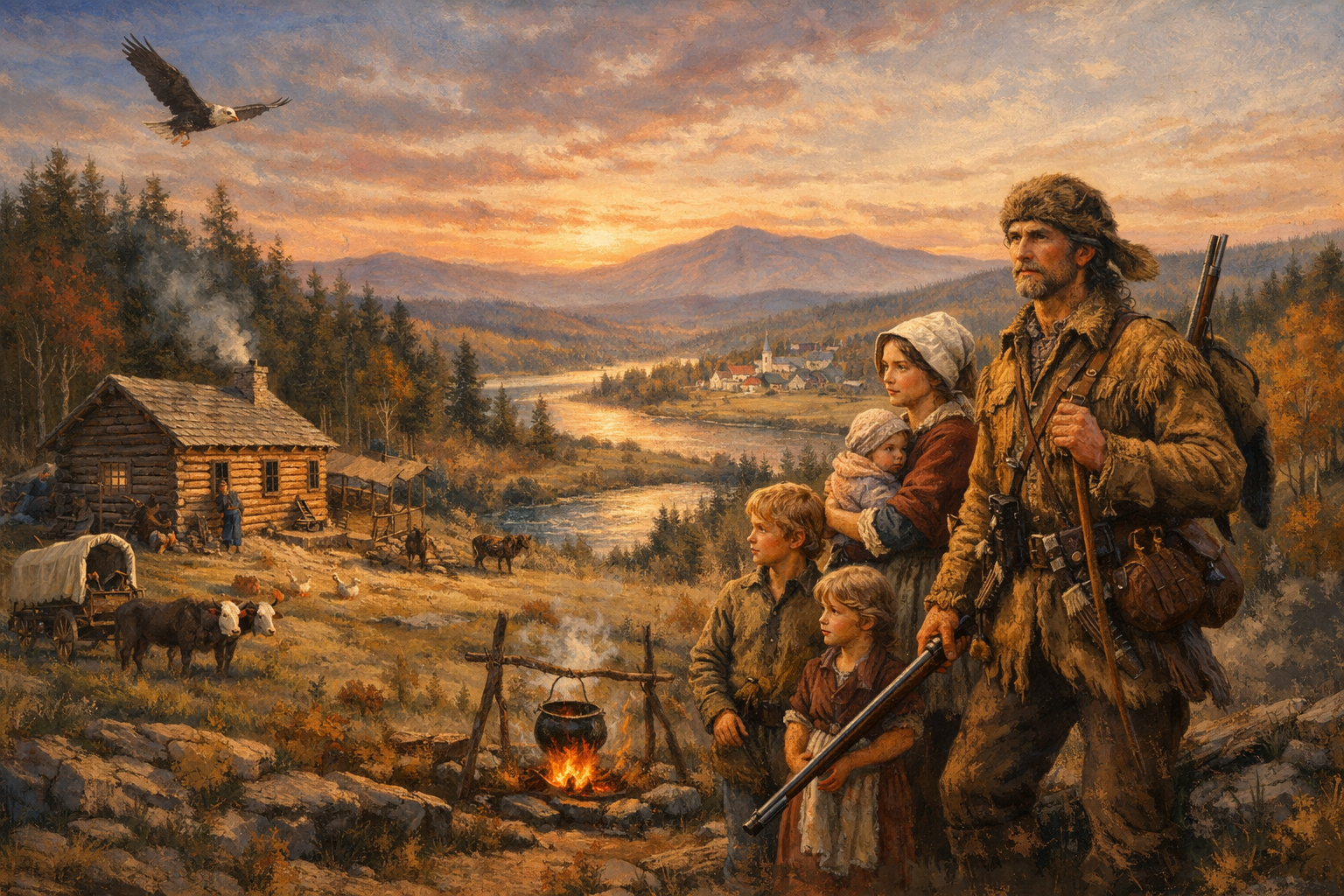
But in the years following the American Revolution, a particular branch of the Goss name took root in a wild corner of Maine known then as the Presumpscot Claim. It lay just west of the Androscoggin River, a stretch of rough land that would soon become the Town of Danville, and later a part of Auburn. Today it is quiet country—fields, woods, and winding roads—but in those early days it was a frontier. In this story, the names Presumpscot, Danville, and Auburn all point to the same place: the cradle of the Danville Goss families.
Long before these settlers arrived, the Goss name had already been known in America for a century and a half. The earliest figures who might be counted among the ancestors of the Danville line appeared along the north shore beyond Boston in the mid‑1600s. But the first man we can name with certainty—the one whose footsteps we can follow without guesswork—is Richard Goss, born in Marblehead around 1662.
Richard stands at the beginning of this story not only because the records place him there, but because his life reflects the spirit that would later define the Danville Gosses. He turned away from the old English villages clinging to the shoreline, still bound to the habits of the mother country, and he struck inland. He chose the uncertainty of new land over the comfort of the familiar. In doing so, he lived out the early shape of what would become the American character.
Generations later, the Danville Goss families would repeat that same pattern. They pushed into what their neighbors called the “howling wilderness,” carving out farms, raising homes, and building a life with their own hands. They sought not only survival but dignity, comfort, and a future for their children. In their courage, one can see the echo of Richard’s first bold step away from the coast.
It is important to understand this: the Danville Gosses are their own people. The Goss name may be shared by many, but this branch has its own heritage, its own story, and its own identity. They are not to be confused with others who bear the same name but come from different roots.
This narrative follows the line of descent from Richard Goss to Harry A. Goss, the central figure of this account. Along the way, many relatives, spouses, and connected families appear, each adding their own thread to the tapestry. The purpose is simple: to trace the unbroken line from the first proven ancestor to the man whose life stands at the end of this genealogical path. Only the information available can be included, but the door is always open for new discoveries and corrections.
The Danville Goss settlers multiplied quickly. Six of the first family’s sons and daughters made their homes in Presumpscot. It is said the sons alone produced thirty‑eight children, and with the daughters’ families added, the second generation likely numbered more than fifty. Before long, twenty Goss men were listed as heads of households in the area. Today, few people in old Danville still carry the Goss name, but their descendants—now bearing many surnames—are scattered across the world by the thousands.
And yet, wherever they are found, many still reflect the same quiet virtues that marked the early Danville Goss family: humility, dignity, honor, and diligence. These qualities, more than the name itself, are the true inheritance of the Danville Goss line.
Stay Tuned for the continuation of this story…