
Researched and Written By: Don Goss
CHAPTER I — The Leaving of England
I will never forget the sound the ropes made as they were cast off — a heavy, final thud against the wooden posts of the Weymouth dock. It was the sound of a door closing behind us, the last sound of England I would ever hear with my own feet still planted on her soil.
The ship lurched as the tide pulled us outward. My mother clutched the rail, her knuckles white, her eyes fixed on the shrinking shoreline. My younger brothers huddled together, wide‑eyed, as if the sea itself might rise up and swallow us whole.
I stood tall — or tried to — but inside me, something twisted. Fear, yes. But also something else. Something like hope, sharp and painful.
The cliffs of Dorset faded into the mist. The gulls circled overhead, crying out as if mourning us.
And then England was gone.
CHAPTER II — Into the Gray Atlantic
The first days were almost gentle. The sea rolled beneath us like a restless sleeper, but the skies were clear, and the wind steady. We ate salted fish and hardtack, drank weak ale, and tried to pretend we were not terrified.
But by the fourth day, the Atlantic showed its true nature.
The wind rose without warning, howling like a living thing. Waves slammed against the hull, sending spray over the deck. The ship groaned, timbers straining, ropes snapping like whips.
I clung to the rail as the deck pitched beneath my feet. The sky was a churning mass of black clouds, the sea a chaos of white foam and green fury.
My mother prayed aloud, her voice trembling. My father shouted orders to my brothers, trying to keep them from being thrown across the deck.
At the height of the storm, when the ship seemed certain to break apart, I heard the captain shout:
“Hold fast! She’s a stubborn old girl — she’ll not die today!”
I wanted to believe him. But the sea had other ideas.
A wave taller than any I had ever seen rose before us, blotting out the sky. It crashed over the deck, sweeping barrels, crates, and two passengers into the dark water. Their screams were swallowed instantly.
We could do nothing. The sea takes what it wants.
CHAPTER III — Hunger, Sickness, and Silence
After the storm, the ocean lay strangely calm, as if exhausted by its own rage. But the damage was done.
The food stores had been soaked. The fresh water barrels were cracked. Several passengers were injured, and two children had fallen ill with fever.
Days blurred into one another. The air below deck grew foul, thick with the smell of sickness, sweat, and fear. Rats scurried in the shadows. The ship creaked endlessly, a sound that burrowed into the mind.
My youngest brother, Thomas, grew pale and thin. He coughed through the nights, his small body shaking. My mother held him close, whispering prayers, but her eyes told me she feared the worst.
One morning, a woman died — a mother of three. The captain read a psalm as her body, wrapped in canvas, was slid over the side. The splash was small, almost gentle.
Her children watched in silence.
After that, no one spoke much.
CHAPTER IV — The Endless Horizon
Weeks passed. The sea stretched in every direction, an unbroken circle of blue and gray. The sky changed, the waves changed, but the horizon never did.
Some days the wind died entirely, leaving us stranded in a vast, shimmering stillness. The sails hung limp. The sun beat down mercilessly. Our tongues swelled with thirst.
Other days, the wind returned with a vengeance, driving us forward but battering us with cold rain and stinging spray.
I learned the rhythms of the ship — the groan of the mast, the slap of the waves, the quiet sobs of passengers in the night.
I learned the taste of fear.
But I also learned something else: resilience.
We were still alive. And every sunrise brought us closer to the New World.
CHAPTER V — Landfall
It happened at dawn.
A shout from the masthead — hoarse, disbelieving:
“Land! Land to the west!”
I scrambled to the rail, heart pounding. At first, I saw nothing but mist. Then, slowly, a dark line emerged on the horizon.
Not clouds.
Not waves.
Land.
Real land.
My mother wept openly. My father bowed his head. My brothers stared in awe.
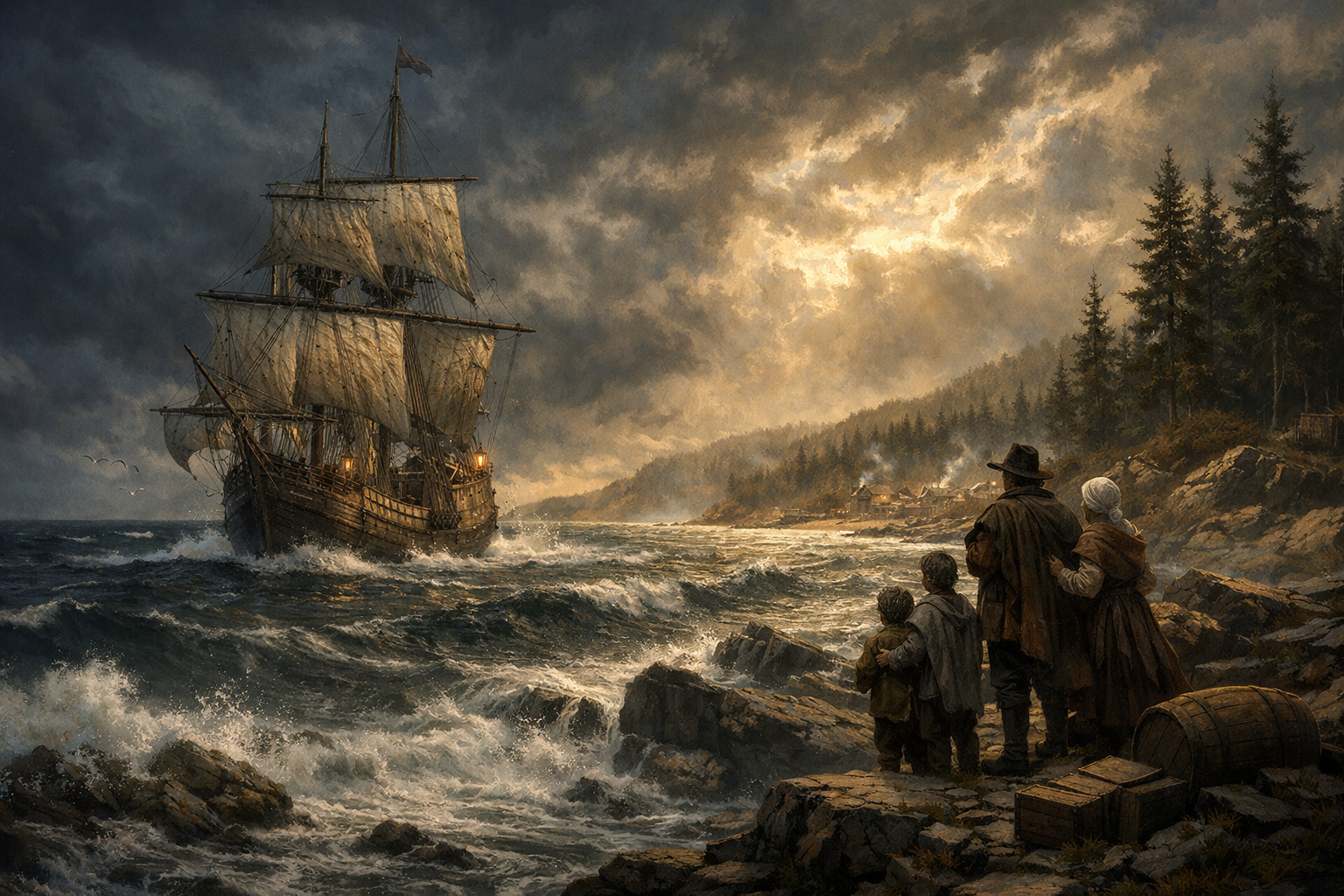
As we drew closer, the coastline took shape — dense forests pressing down to the water’s edge, smoke rising from distant settlements, the rugged, untamed beauty of a world untouched by the centuries of toil that had worn England thin.
The air smelled different — sharp, clean, wild.
I breathed it in as if it were life itself.
CHAPTER VI — First Steps in the New World
We anchored in the harbor of Marblehead, a rough settlement of wooden houses, muddy paths, and fishermen hauling nets heavy with cod.
It was nothing like England.
It was better.
The people here walked with purpose. Their clothes were worn, their hands calloused, but their eyes held something I had never seen in the old country:
Possibility.
A man could rise here. A man could build something that belonged to him and no one else.
We stepped onto the rocky shore, our legs unsteady after weeks at sea. The ground felt strange beneath my feet — solid, unmoving, full of promise.
A man approached us, his beard thick, his coat patched but warm.
“You’re new arrivals,” he said. “Welcome to Massachusetts Bay. You’ll find work here if you’re willing.”
Willing.
We were more than willing.
We were desperate. We were hopeful. We were ready.
CHAPTER VII — The Beginning of the Goss Legacy
Those first days were hard. The nights were cold. The work was backbreaking. But it was our work, in a land where no landlord stood over us demanding rent we could not pay.
We built a small shelter. We learned the ways of the coast — the tides, the fish, the forests. We traded with neighbors. We prayed with them. We mourned with them.
Slowly, the fear faded.
Slowly, the New World became home.
And as I stood on the rocky shore one evening, watching the sun sink into the vast western wilderness, I felt something I had never felt in England:
Belonging.
This land was harsh, yes. But it was honest. It gave nothing freely, but it took nothing unjustly.
Here, a man could shape his own destiny.
And so the Goss family began its American story — not with triumph, but with courage. Not with wealth, but with hope.
A hope strong enough to cross an ocean.
A hope strong enough to build a legacy that would endure for centuries.