
Researched and Written By: Don Goss
Prologue — The Wind Before the Storm
England in the mid‑1600s was a land of tension. The Civil War had left scars on every village, every hearth. Taxes rose, harvests failed, and the old fishing towns along the southern coast felt squeezed between poverty and the sea. Rumors drifted across taverns and marketplaces — rumors of a wild continent across the ocean where land was plentiful and a man’s future was not dictated by birth.
In the village of Lyme Regis, where the cliffs leaned over the roaring Channel, the Goss family listened.
Thomas Goss, a fisherman hardened by salt and storms, had lost two brothers to the sea. His wife, Anne, feared that if they stayed, the ocean would eventually claim him too. Their eldest son, Richard, barely ten, watched the horizon with a mixture of dread and wonder.
When word came that a merchant vessel — the Providence — would soon sail for the Massachusetts Bay Colony, Thomas made the decision that would shape centuries of descendants:
“We go,” he said. “Before the sea takes more from us.”
Chapter I — The Gathering of Souls
The docks were chaos. Families huddled with bundles of clothing, crates of salted meat, tools, and the few possessions they dared bring. Chickens squawked in cages. Children cried. Sailors shouted orders over the wind.
The Providence was no grand ship. Her hull bore scars from years of hard service. Her masts creaked like old bones. But to the Goss family, she was a lifeline.
As they boarded, Anne clutched Richard’s hand so tightly he winced. Thomas carried a small chest — inside it, a Bible, a fishing knife, and a pouch of soil from their English garden.
“Something to remember home,” he whispered.
They were not alone. Among the passengers were:
- The Whitfields, a stern Puritan family seeking religious freedom
- The Carters, farmers who had lost their land to debt
- A young widow, Margaret Hale, traveling alone with her infant
- A carpenter, Elias Turner, whose laughter carried even over the wind
Each family carried its own story, its own hopes, its own fears. But once the ropes were cast off, they became one company — bound together by the vast, merciless Atlantic.
Chapter II — Into the Maw of the Sea
The first days were deceptively calm. The ship glided over gentle swells, and the passengers dared to believe the crossing might be easier than they’d feared.
But the Atlantic is a creature of moods.
By the second week, storms rose like mountains. The Providence pitched violently, her timbers groaning. Waves crashed over the deck, drenching everything in icy spray. Children were tied to their mothers to keep them from being thrown.
Richard remembered the moment the lanterns went out — the ship plunged into darkness, lit only by lightning that split the sky like a divine warning.
“Hold fast!” the sailors cried.
Thomas wrapped his arms around his family as the ship lurched. Anne prayed aloud, her voice trembling.
For three days the storm battered them. Barrels broke loose. A mast cracked. A sailor was swept overboard, his scream swallowed by the wind.
When the storm finally passed, the sea lay eerily still. The survivors emerged from the hold like ghosts.
They had crossed a threshold — not just of distance, but of spirit.
Chapter III — Hunger, Hope, and the Edge of Despair
Weeks dragged on.
Food dwindled. The salted fish grew rancid. Water barrels soured. Sickness crept through the cramped quarters — fever, coughs, the dreaded “ship’s flux.”
Margaret Hale’s infant grew weak. Anne spent hours helping her, singing soft hymns to soothe the child. But one cold dawn, the baby’s cries fell silent.
The burial at sea was brief. The sailors wrapped the tiny body in cloth, weighted it with stones, and slid it into the deep. Margaret collapsed, and even the stern Puritans bowed their heads.
Richard never forgot the splash — or the way the ocean closed over the child without a ripple.
Yet even in sorrow, life persisted. Elias the carpenter carved toys for the children. Thomas taught Richard to tie knots and read the stars. Anne shared what little food she had with those worse off.
Hardship forged them into something stronger.
Chapter IV — The Cry from the Masthead
It happened on a morning thick with fog.
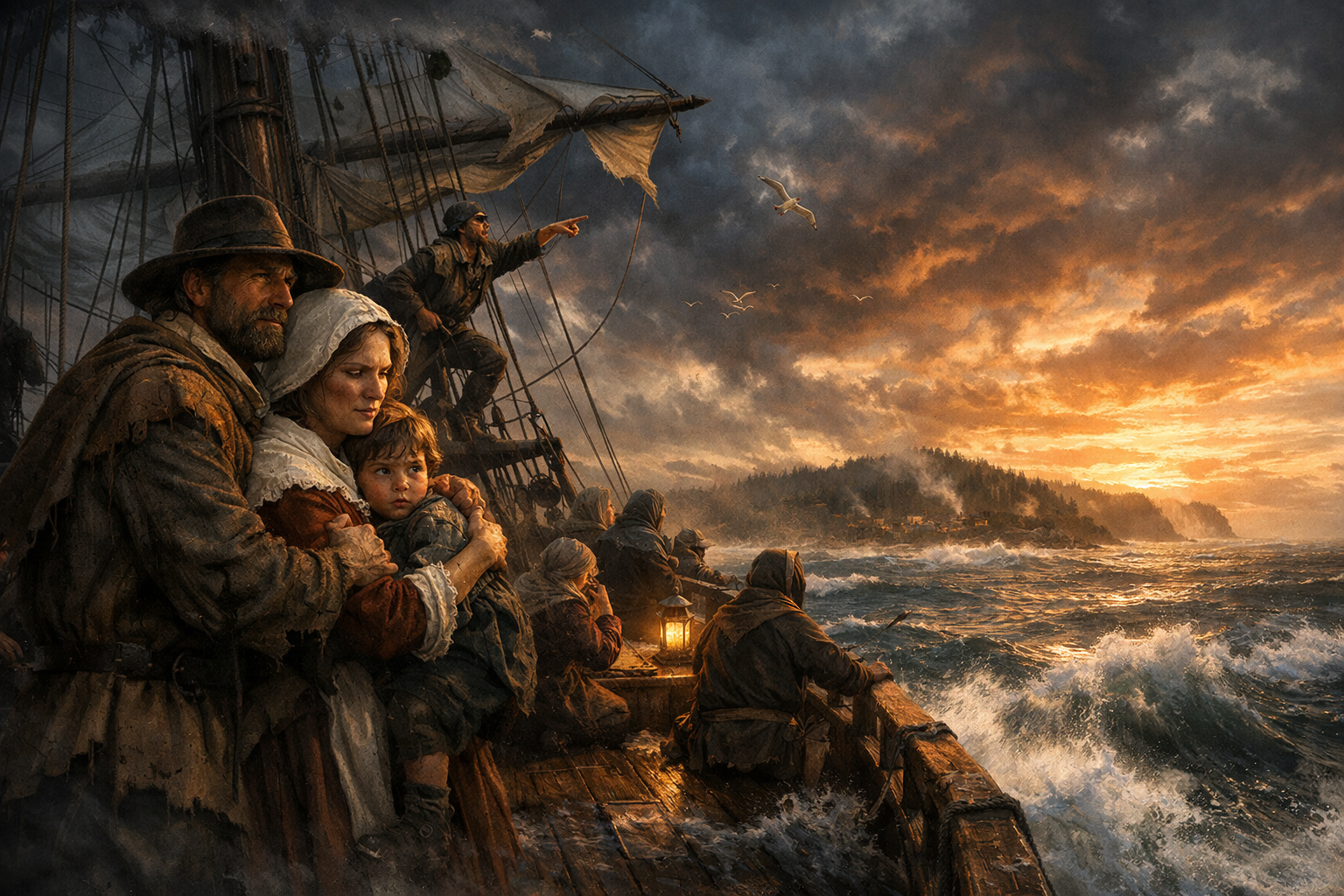
A sailor perched high in the rigging suddenly shouted, voice cracking with disbelief:
“Land! Land to the west!”
Chaos erupted. Passengers surged to the railings, straining to see. Slowly, through the mist, a dark line emerged — not cloud, not wave, but shore.
Forests. Endless forests. Smoke rising from distant settlements. A coastline wild and untouched.
Anne wept. Thomas fell to his knees. Richard felt something ignite inside him — a fierce, bright hope.
After nearly two months at sea, they had reached the New World.
Chapter V — First Steps on Strange Soil
The Providence anchored in the cold waters of Massachusetts Bay. Small boats ferried the passengers to shore. When Richard stepped onto the rocky beach, the ground felt unreal beneath his feet.
The air smelled of pine and earth — richer, sharper than England. The trees towered like giants. The settlement nearby was small but alive with activity: men sawing timber, women tending fires, children chasing each other through the mud.
A man in a broad‑brimmed hat greeted them.
“Welcome to the Bay Colony,” he said. “You’ll find the land harsh, but the opportunities plentiful.”
The Goss family settled first in Marblehead, a rugged fishing village where the sea was both livelihood and threat. Thomas returned to fishing, but now the waters were new, the catches larger, the future brighter.
Anne planted a small garden with the soil she had brought from England. Richard grew into a young man shaped by the frontier — strong, curious, unafraid of the unknown.
Epilogue — The Legacy Begins
Years later, Richard would tell his own children about the voyage:
- The storm that nearly broke them
- The hunger that tested them
- The moment the coastline appeared like a miracle
He would tell them that courage is not the absence of fear, but the decision to move forward despite it.
From that first crossing grew the long line of Goss families in Maine, settlers of Danville and Auburn, farmers, soldiers, craftsmen, and dreamers.
The story of the Goss family in America began not with wealth or privilege, but with a leap of faith across a dangerous sea — a leap that echoes through every generation that followed.