Written by: Don Goss 32° KCCH
Brethren, when we speak of the Ancient and Accepted Scottish Rite in the United States, we are really speaking about two sister jurisdictions that share a common heritage but have grown into distinct expressions of the same Masonic tradition. These are the Southern Jurisdiction (SJ) and the Northern Masonic Jurisdiction (NMJ). Both uphold the same ideals, the same commitment to Masonic light, and the same 32° system of moral instruction, yet each has its own history, culture, and administrative character. Understanding these differences helps us appreciate our own identity here in the Valley of Tallahassee, which proudly belongs to the Southern Jurisdiction.
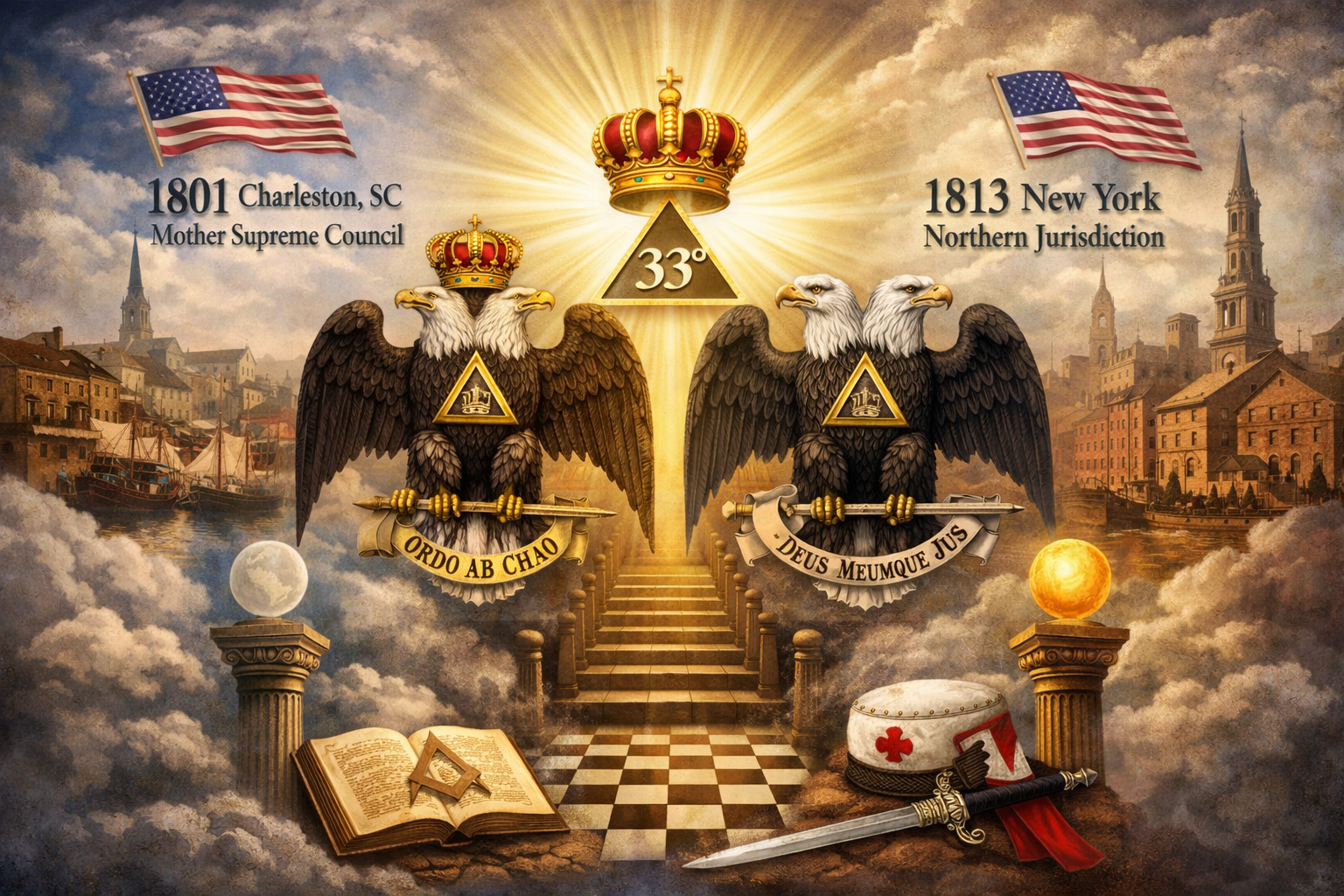
The Scottish Rite in America began in 1801 in Charleston, South Carolina, with the formation of the first Supreme Council in the world. This event marks the official beginning of the Scottish Rite as we know it. That original body—what we now call the Southern Jurisdiction—became known as the “Mother Supreme Council of the World,” and it set the pattern for Scottish Rite organization across the globe. As the Rite expanded, the need for administrative efficiency became clear. In 1813, a charter was issued establishing a second Supreme Council in New York, which became the Northern Masonic Jurisdiction. This division was not the result of political conflict or the Civil War; it was simply a practical solution to managing a rapidly growing fraternity.
The Southern Jurisdiction, founded in 1801 and headquartered today in Washington, D.C., covers thirty‑five states, including all of the South and West. It is the oldest and most widely recognized Scottish Rite authority in the world. Its ritual style tends to be philosophical, allegorical, and universalist, emphasizing the moral development of the Mason and the pursuit of enlightenment. Florida—and therefore Tallahassee—is firmly within this jurisdiction. The SJ’s structure is organized into Orients (states) and Valleys (local bodies), and its degrees reflect the influence of Albert Pike and generations of scholars who shaped the Rite’s philosophical depth.
The Northern Masonic Jurisdiction, founded in 1813 and headquartered in Lexington, Massachusetts, covers fifteen states in New England, the Mid‑Atlantic, and the Midwest. While it shares the same core mission and degree system, the NMJ developed its own ritual revisions and administrative traditions. Its degrees are often grouped into thematic programs and are known for their dramatic presentation. The NMJ has historically embraced innovation in how degrees are staged and communicated, giving it a distinct cultural identity within the broader Scottish Rite family.
Although both jurisdictions are fully regular and in amity, several differences distinguish them. The most noticeable is ritual. The Southern Jurisdiction follows Pike’s philosophical revisions, emphasizing symbolism, moral philosophy, and universal truths. The Northern Jurisdiction uses its own revised rituals, often presented in dramatic or thematic formats. Administratively, the SJ’s structure of Orients and Valleys differs slightly from the NMJ’s system, and each jurisdiction has its own traditions regarding officer titles and governance. Culturally, the SJ is known for its global influence and philosophical depth, while the NMJ is known for its creativity and innovation in degree presentation.
Understanding these differences matters for us in the Valley of Tallahassee because it helps us appreciate who we are and the heritage we uphold. As part of the Southern Jurisdiction, we belong to the oldest Supreme Council in the world, connecting us directly to the earliest roots of Scottish Rite Masonry in America. Our ritual tradition emphasizes moral duty, personal enlightenment, and the universality of truth—values that resonate deeply in a city like Tallahassee, where education, civic engagement, and public service are central to community life.
Our Valley reflects the Southern Jurisdiction’s mission of education, charity, leadership development, and community impact. As a Valley located in the state capital, we are uniquely positioned to embody these values through public outreach, Masonic education, and service to our community. Understanding our jurisdictional identity also helps us explain the Rite to new Brothers who may be curious about why two jurisdictions exist and what distinguishes them. We can confidently tell them that both are legitimate, both share the same mission, and we simply belong to the older, more philosophically oriented jurisdiction.
Most importantly, knowing our heritage strengthens our identity as a Valley. It gives us pride in our lineage, clarity in our mission, unity in our work, and purpose in the degrees we confer. It reminds us that we are part of something ancient, global, and profoundly meaningful.
Brethren, the story of the Scottish Rite in America is a story of growth, unity, and the pursuit of light. The Southern and Northern Jurisdictions are two branches of the same great tree—each with its own character, but both rooted in the same soil of Masonic brotherhood. For us in the Valley of Tallahassee, understanding this heritage deepens our appreciation of the work we do, the degrees we confer, and the legacy we uphold. May we continue to labor faithfully in the quarries of the Rite, ever seeking more light.