
Researched and Written By: Don Goss
TRANSPORTATION — A WORLD HELD TOGETHER BY HORSEFLESH AND HOPE
In the early years of the Harry Goss family, the world beyond the farm felt farther away than any map could show. Leaving home meant preparation—long, exhausting preparation. Chores first, always. Then baths drawn from water heated on the stove, children scrubbed and dressed, tempers soothed, boots laced, and finally the slow gathering of the family toward the waiting horse. As the document puts it, “With the whole family to get ready and horse transportation it was not easy.”
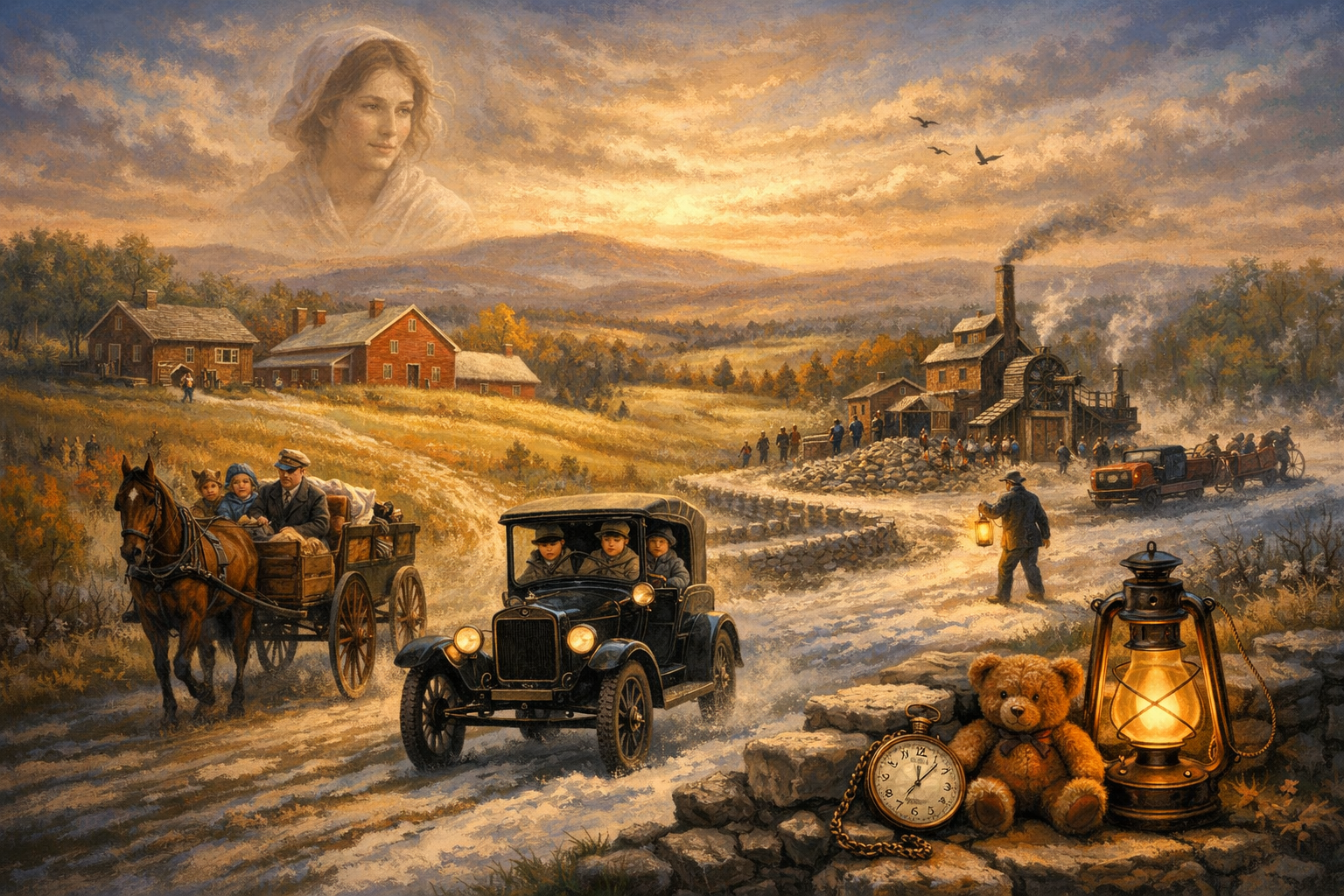
Summer meant a wagon—two seats if the trip was modest, three if the whole clan was going. Winter meant the pung, a sleigh-like contraption with two seats and a belly full of blankets, robes, and soapstones warming cold feet. Sometimes, when the family traveled en masse, even the pung wasn’t enough, and a full sled was hitched instead.
Harry himself never trusted automobiles. He loved a horse the way some men love a craft or a calling. When he imagined retirement, he pictured himself behind a horse and buggy, trotting down back roads to visit friends. And truthfully, on Harris Hill, a car would have been a fool’s gamble. Spring roads dissolved into mud so deep that even schools closed for weeks.
Those who did own automobiles treated them like fragile summer creatures. Winter meant jacking them up on blocks and leaving them to hibernate. Sleighs and pungs ruled the roads then, gliding over snow packed hard by the great roller pulled by four horses. Children watched in awe as Charles Pulsifer’s roller thundered past, flattening the snow so firmly that, as the document notes, “the snow would stay on the roads even when the fields… were bare.”
But time has a way of insisting on change. Eventually Harry conceded that the family needed a car—mostly because Harold was old enough to drive. The first automobile, bought from neighbor Elmer Durgin for $20, was a Model T that barely held itself together, but it represented a new era. “It wasn’t much of an automobile… but it worked and everyone rejoiced.”
The next car, a Studebaker, looked promising but died young. Still, the boys were learning—about engines, about the wider world, and about the unpredictable nature of early motoring.
One winter morning, Will and Paul were driving a teacher to school when the car sputtered and died two miles from town. Their passenger, exasperated, leapt out and sprinted down the road “with her long legs pumping like sixty miles an hour.” By the time the boys coaxed the engine back to life, she was striding through the school door. When they entered moments later, she fixed them with a look and said, “You think you’re smart!” The brothers never forgot it.
STONEBREAKERS — THE YEAR THE HILL SHOOK
In 1927, Harris Hill awoke to the sound of hammers.
The State of Maine had hired a company to build a new stretch of highway, and the company chose the Lane farm—just beyond the Goss home—as the site for their stone crusher. The Lanes, the document notes, “must have really regretted that bargain a thousand times.”
Soon the company began buying up stone walls from neighboring farms. When the agent visited Harry—who was bedridden from a farm accident—he made his pitch: “I’ll remove those ugly old stone walls for you and build good fences of barbed wire.”
Harry knew better. Those walls were the pride of New England farms—permanent, beautiful, and strong. Barbed wire was a nuisance that demanded constant upkeep. But money was money, and eventually a deal was struck: $400 and twenty rolls of wire.
Spring brought chaos. Roads were carved across the fields. Crews of Portuguese laborers from Massachusetts worked for months, pounding stones with hammers until trucks could haul them to the crusher. Dust clouds rose like smoke. The quiet hill became a worksite of strangers, noise, and upheaval.
Yet even disruption brings unexpected gifts. The new roads were a blessing. And the laborers—whom the neighbors initially feared—proved honest, hardworking men. The only trouble, the document says gently, was “a sanitary one,” and even that was not their fault.
EDUCATION — THE GOSSES AND THE PURSUIT OF LEARNING
Education was the heartbeat of the Goss household.
Ruby Edwards Goss had attended Pennell Institute, unusual for her time, and though she couldn’t finish due to family needs, she never stopped learning. She read constantly, wrote beautifully, and insisted that every one of her children would finish high school.
Harry, too, had been shaped by education. He attended Monmouth Academy and had been tutored in subjects far beyond the local curriculum—classics, languages, history. He later taught at the Patten School and served as Superintendent of Schools in Greene. His children’s schooling mattered deeply to him.
The younger Goss children attended the little schoolhouse at Harris Hill—a tiny, aging building heated by a woodstove. An older boy earned ten cents a day to sweep, dust, and fetch water. Lessons were recited on a front settee while other students worked at their desks… or pretended to. As the document notes, “a third grade pupil would know all about nouns and verbs… because he listened.”
High school meant Mechanic Falls, with its new 1928 building, gymnasium, clubs, sports, and prize-speaking contests. Harry coached his sons tirelessly, helping them choose dramatic pieces and drilling them daily. Will’s performance of Ben Hur became legendary—audiences swore they could hear the chariots thundering across the stage.
ACCIDENTS AND ILLNESS — THE FRAGILITY OF FARM LIFE
Farm life carried risks, though the Goss family was fortunate. One scare came when young Julian darted across the road and was gently bumped by Mr. Briggs’s slow-moving automobile. He was unhurt, but the sight of Harry sprinting from the orchard remained etched in memory.
Cuts, bruises, and bare-foot mishaps were common. The cure was always the same: soak in creolin, dab with iodine, wrap, and carry on. Measles struck hard—Ruby and Paul nearly died. Old Doctor Rankin traveled from Mechanic Falls in the night, and, as the document recalls, “saved Paul’s life.” He accepted payment in eggs.
Harry served as the family medic, sewing cuts, tending animals, and keeping danger at bay.
THE LIFE STYLE — A MORAL COMPASS IN A CHANGING WORLD
The Goss family lived simply but with deep conviction. Each morning began with the Lord’s Prayer. Children learned Scripture, humility, and the quiet dignity of being “common men”—equal to all, lesser than none, and always accountable to God.
Integrity, kindness, and responsibility shaped their days. These values, the document says, were taught so well that “all seven… maintain it… and intend to follow in that way as long as they live.”
THE GIFT OF LOVE — THREE STORIES THAT SHAPED A FAMILY
The Organ
Abbie Blaisdell Goss loved music, but an organ was far beyond the young couple’s means. Harry saved in secret, scraping together the enormous sum—“perhaps $600”—and ordered the organ without telling a soul.
But neighbors talk. One saw Harry driving home with something large in the wagon and called Abbie to ask if it could possibly be an organ. So the surprise was spoiled, but the joy was not. Abbie’s delight filled the house, and the organ remained a treasured symbol of sacrifice and love.
The Watch
As a teenage bellboy at Ricker Inn, Harold earned tips slowly—dimes at a time. One summer he saved $75, the next $150. With his father’s blessing, he bought his mother the finest watch he could afford.
Her astonishment and joy became one of the defining memories of Harold’s life. The document calls it “one of the most enriching experiences he ever had.”
The Teddy Bear
One Christmas, little Ara received a magnificent teddy bear from the church—a gift far beyond the usual modest offerings. On the long ride home in the pung, he fell asleep clutching it… until suddenly it was gone.
The family searched the sleigh. Nothing. Harry lit a kerosene lantern and walked back into the winter darkness. The children watched the tiny light bob along the road, then vanish. They shivered, waited, hoped.
He returned empty-handed. The bear was lost. But the memory that endured was not the loss—it was the love in the searching, the waiting, the shared sorrow. As the document says, “A gift even much greater than the wonderful bear had been given that night.”
A Gift of Life
In 1939, Ruby fell gravely ill. The doctor told Harry and Elwood bluntly that she had a coronary thrombosis and would likely not survive. The drive home was heavy with dread.
Harry, usually reserved, spoke openly to his son about his fear of losing another wife. “This is more than I can bear,” he said.
But Ruby recovered. She lived seven more years, a gift Harry never took for granted.