
Researched and Written By: Don Goss
Long before the Goss family ever set foot on the rocky soil of Maine, their story unfolded along the salt‑stung coast north of Boston. Generations of them lived by the rhythm of the Atlantic—its tides, its storms, its hard‑won harvests. It was a world of fishing boats, narrow harbor streets, and the constant cry of gulls overhead. Out of this world came the first ancestor we can name with certainty: Richard Goss of Marblehead, born around 1662.
Richard grew up in a town where every boy learned to read the sea before he could read a book. As a young man, he and his wife Mary left Marblehead for Star Island, one of the Isles of Shoals off the New Hampshire coast. Life there was rugged and wind‑swept, but Richard thrived. He became a selectman, a fisherman, and a man trusted by his neighbors. For a time, the island was home—until the pull of the mainland drew him back. He eventually settled in Ipswich, Massachusetts, where his grave can still be found, a quiet marker of a life spent in service to coastal communities. He died around 1715.
His son Thomas, born around 1700, carried the family name to Gloucester, another town shaped by the sea. He married Patience Harridan, but his life was cut short; he died before his son—also named Thomas—was even born. That son, Thomas Goss (1730), grew up to become a respected figure in Gloucester and nearby Rockport. For more than five decades he served his community, held local offices, and built a reputation as a capable and steady man. Only in his later years did he turn his eyes northward, toward the unsettled lands of Maine.
What lies before Richard in the family line remains a mystery. Genealogists have tried to push the story further back—some toward Isaac Goss, recorded in 1638, others toward Edward Goss, who appears in Marblehead records around 1660. And there is the tantalizing possibility, still unproven, that the family descended from Sir Thomas Goss of London, a marine merchant involved in the earliest plans for the Plymouth and Massachusetts Bay colonies. But for now, these remain threads waiting to be tied.
The Journey North
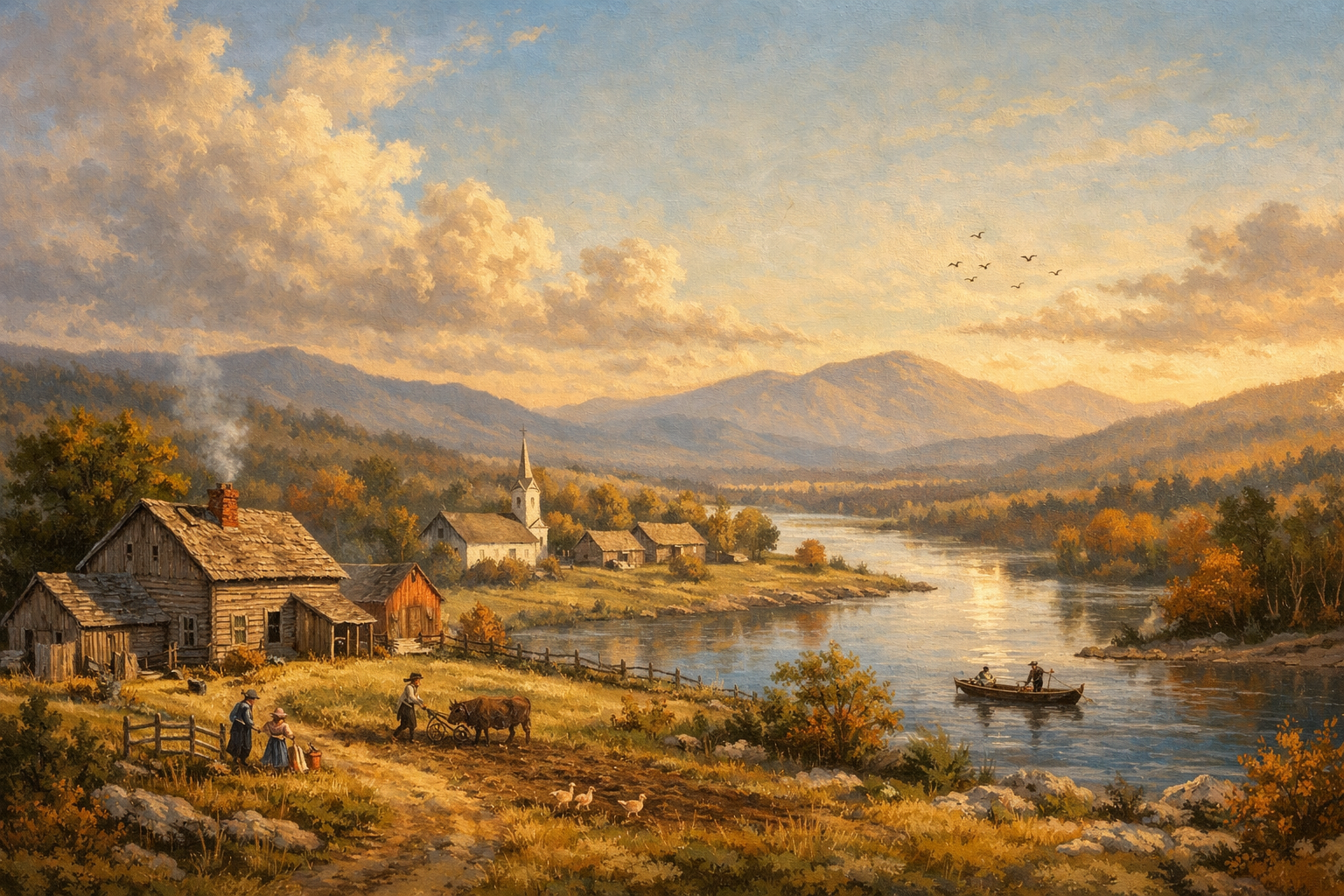
The decisive turn in the family’s story came in 1786, when the Gosses left the familiar shores of Massachusetts and journeyed into the wooded interior of Maine. They came to settle on the Pejepscot Claim, a vast tract of land that would later become the Town of Danville in Cumberland County. In time, Danville itself would be absorbed into the growing City of Auburn, and the area where the Goss family built their homes would come to be known as South Auburn.
To the Gosses, however, the name mattered less than the land itself. They arrived to find dense forests, rough clearings, and the promise of a new beginning. Here they carved out farms, raised families, and laid the foundations of a community that would endure long after the old town names faded from maps.
Preserving the Record
The story of the Danville Goss family survives today thanks to the work of many hands, but none more dedicated than Dr. George Hathorn Smith, a descendant and a medical professor at Yale University. Over many years he gathered letters, records, recollections, and fragments of family lore, assembling them into a careful and invaluable archive. Private copies of his research still exist, and they form the backbone of what we know.
Other families contributed their own pieces—Bible records, notes tucked into drawers, memories passed down through generations. Together, these sources allow the Goss story to be told with clarity, even if some branches of the family tree remain incomplete.
The Family Tree
Much remains unknown. Census records, wills, and deeds have not been exhaustively searched beyond Dr. Smith’s work. Yet the facts we do have—though sometimes sparse—are compelling. They reveal a family shaped by the sea, strengthened by hardship, and bold enough to leave everything familiar behind in search of a new life in Maine.
This narrative is built on the best information available, and every effort has been made to present it faithfully. It is not just a genealogy—it is the opening chapter of a family’s long American story.
How the Record Was Shaped
As the generations multiplied and the branches of the Goss family spread across Maine, the task of preserving their story became more than a simple listing of names. It required structure—something sturdy enough to hold the weight of two centuries, yet flexible enough for future hands to add their own discoveries. For that reason, the compiler of this genealogy arranged the material into chapters, each devoted to a particular branch of the family. Some chapters unfold into smaller sub‑chapters, allowing each line to remain close to its kin, just as the families themselves once lived near one another along the roads of Danville and South Auburn.
The names appear twice in these pages, but not by accident. The first appearance is in childhood, listed in a right‑hand column beneath the names of their parents. The second appearance comes later, in adulthood, when each individual steps forward into the left‑hand column with the details of his or her own life. Beside each adult name stands the first name of the Goss parent from whom they descend—a quiet guidepost to help the reader trace the line back through the generations.
It is a system designed not for scholars but for families—for those who may be opening these pages for the first time, curious about the people whose lives shaped their own. Anyone puzzled at first will soon find the rhythm of it. The compiler worked deliberately to create something clearer and more intuitive than the usual genealogical tables, something that an amateur historian or a curious grandchild could follow without frustration.
Nothing here is copyrighted. The story belongs to the family, and to anyone who wishes to carry it forward.
What the Record Contains—and What It Cannot
Every town mentioned in these pages lies in Maine unless otherwise noted. The presence or absence of detail does not reflect the importance of a life, only the survival of records. The compiler used what could be found—church books, town ledgers, family Bibles, gravestones, and the memories of those who still remembered the old stories. Each chapter closes with a date marking the latest information known at the time. After that, the record is open to correction, expansion, and rediscovery. Future generations may add what time has hidden.
The numbering of generations begins with Thomas Goss, the first of the family to settle in Maine. He stands as the First Generation, the root from which all later branches grow. Each chapter begins anew with its own page numbers, marked by the chapter number and a dash, a small but useful compass for navigating the material. At the end of each chapter, an index lists the primary individuals for quick reference.
The men whose names appear as the heads of Chapters Two through Nine were all grandsons of Thomas the Pioneer. Their fathers—Thomas II, Joshua I, and John I—were the sons who carried the family into its second generation in Maine. From them came the many lines that would spread across Danville, Auburn, and beyond.
A Living Record
This genealogy is not a monument carved in stone. It is a living document, shaped by the hands of those who care enough to preserve it. The compiler gathered what he could, but he knew that others would follow—descendants who might uncover a forgotten letter, a missing date, or a story that had slipped between the cracks of time.
In that spirit, this record stands not as a final word, but as an invitation: to remember, to discover, and to continue the work of telling the Goss family story.