
Companions, as we gather for our Chapter’s annual church service, we are reminded that our fellowship extends beyond the walls of our Lodge and into the sacred space of worship. Tonight, we come not only as Masons but as seekers of divine truth — united in faith, charity, and brotherly love.
It is a special blessing that this service coincides with our Commandery’s Christmas observance, for both occasions call us to reflect upon the same eternal message: that God is present in every circumstance. Whether in the grandeur of a cathedral or the humbleness of a stable, His light shines upon those who seek Him.
As an ordained minister of the Universal Life Church, I offer this sermon not as a formality, but as a heartfelt meditation — a reminder that the God who guided the builders of Solomon’s Temple also guides us through the challenges and triumphs of our daily lives. May these words inspire us to carry the lessons of faith, humility, and service into all we do as Companions and as men of honor.
“And she brought forth her firstborn son, and wrapped him in swaddling clothes, and laid him in a manger; because there was no room for them in the inn” (Luke 2:7 KJV).
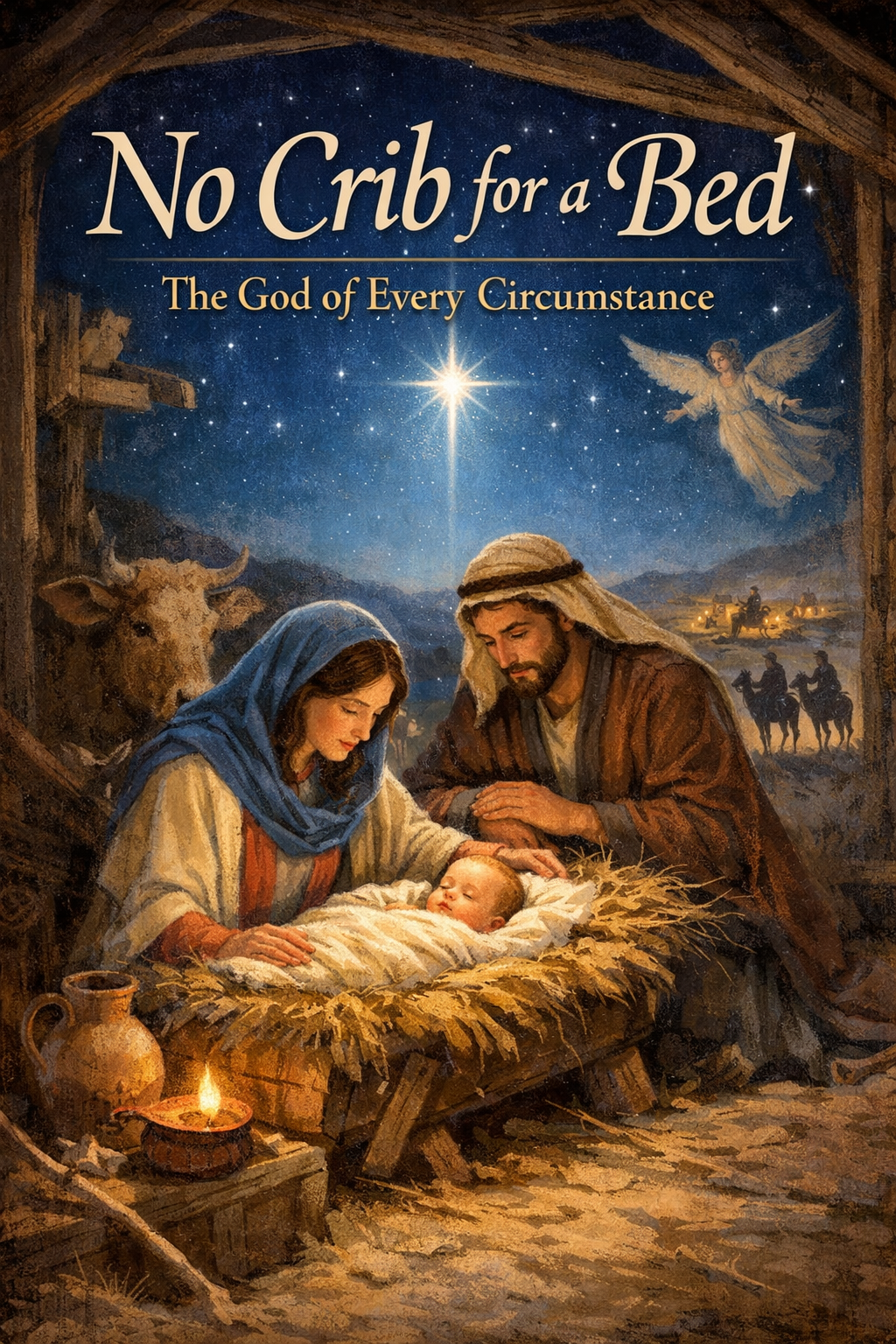
During my preparation for this message, I encountered a sermon entitled “Miracle on Manger Street,” a title that is both memorable and apt, as it captures the significance of the event described in Luke 2:7. The depiction of Christ’s birth has become universally recognizable, often referred to as a creche—an artistic or performative representation featuring Joseph, Mary, and Jesus. Typically, these portrayals are set in a pastoral environment: Mary and Joseph observe the infant Jesus resting in a clean wooden feeding trough, sometimes illuminated by a soft glow. The scene is commonly complemented by fresh straw, starlit skies, and the presence of cattle, sheep, and a donkey. Additionally, shepherds and Wise Men are frequently included, shown respectfully paying homage to the newborn. This depiction presents a serene and evocative interpretation of the nativity.
The creche is not without controversy. Today, placing one on government property—or even in most public spaces—can invite lawsuits and almost inevitably offend someone. Yet the deeper issue isn’t about offense at all. The real problem lies in the disconnect between the serene image we present and the reality of that night in Bethlehem. It was hardly peaceful, certainly not spotless, and far from the idyllic beauty we imagine. Moreover, there is no evidence that the shepherds and the Wise Men ever encountered Jesus at the same time.
The central issue lies in one key aspect: The Son of God arrived from heaven and was born in a stable due to the lack of available accommodations. This is a detail that is frequently mentioned and, perhaps, often overlooked; however, it prompts important reflection. To examine this element of Jesus’ birth, consider the following questions: 1) What concerns arise from this situation? 2) Why might God have permitted it? 3) What lessons can be drawn from it? From a human perspective, it may appear inappropriate for Jesus to have been born in such circumstances—yet this was the reality. It is likely not coincidental, but rather carries a meaningful message for consideration.
1) What’s wrong with this picture?
The answer is clear: Jesus does not belong in such a place. He is the Son of God, sent from heaven, and He should never be treated as though He were a vagrant or a criminal. He deserves the finest this world can offer. Yet He comes from heaven to earth—and is laid in a stable. How can that be? Let me press the point further. God could have arranged it differently. Imagine for a moment that you held all power and could choose the time, the place, and the manner of your child’s birth. Would you choose a stable, exposed to the elements? Of course not. It defies reason. So what is happening here? Why would God allow this? Why was there no room in the inn?
It is appropriate to begin with an overview of Bethlehem. Presently, Bethlehem is a moderately large and active Arab town located approximately seven or eight miles south of Jerusalem, accessible by a main paved roadway. The region remains politically sensitive, and while it is technically possible to walk from Jerusalem to Bethlehem in one or two hours, such travel is not recommended due to current security concerns. In contrast, during the era of Jesus, Bethlehem was a small Jewish settlement, considered one of the lesser towns within Judah. Described by some historians as a “hamlet,” Bethlehem comprised mostly shepherds, farmers, and a few merchants. Its significance primarily derives from its status as the birthplace of King David.
Part of the story tells of Caesar Augustus in distant Rome, who ordered a census so taxes could be gathered across the Empire—a decision said to be guided by God. The census required Jewish men to return to their ancestral towns to register. Because Joseph was a descendant of David, he needed to travel to Bethlehem. Coincidentally—or rather, as orchestrated by divine timing—Mary reached the final stages of her pregnancy just as they arrived in Bethlehem. The term “happened” is used deliberately, suggesting God’s hand ensured everything unfolded perfectly: the emperor made his decree precisely when needed, allowing Mary and Joseph to be in Bethlehem at the moment predicted by the prophet Micah (Micah 5:2) for Jesus’s birth. What appeared as mere chance was, in fact, God directing events throughout history to fulfill his goals. “If God ordains it, he will make a way.”
Not the Holiday Inn
Our difficulty in interpreting this story often comes from our understanding of the word “inn.” Being so used to American culture, we picture something like a Bethlehem Holiday Inn or perhaps a Jerusalem Hampton Inn—modern hotels such as Ramada, Sheraton, or Hilton. We imagine a comfortable building by the freeway, several stories high, complete with a parking lot, spacious lobby, a pool, a hot tub, soda machines on every floor, hot showers, cable TV, and even phone jacks for Internet access. For us, “roughing it” might just mean dealing with a broken ice machine.
It is advisable to set aside preconceptions about ancient travel accommodations. Within the Roman Empire, inns did not provide the amenities found in even a standard modern hotel. Travel during this period was characterized by considerable discomfort, difficulty, and risk, with basic comforts often unavailable. The primary function of an inn was to offer travelers safety from highway robbers by providing a secure place to rest overnight. Modern conveniences such as indoor plumbing were nonexistent, and contemporary forms of entertainment, like Disney+ or Hulu, were centuries away.
To fully comprehend the context, it is important to note that Luke employed two distinct terms for “inn” in his gospel. One term refers to a modest structure designated for accommodating travelers. In such establishments, animals like horses and donkeys were secured at one end, while, for a fee, guests could rest on basic mattresses placed on the floor. The innkeeper was responsible for maintaining the fire and supplying fodder for the animals. This type of “inn” is referenced by Jesus in the Parable of the Good Samaritan (Luke 10:34). Travelers journeying along the historic route from Jericho to Jerusalem may encounter the “Inn of the Good Samaritan,” a straightforward building situated at the traditional location of the inn believed to have existed during the time of Jesus.
In recounting the birth of Jesus, Luke employs a distinct term for “inn” in verse 7 that more accurately refers to a guest room. This type of lodging would have been even smaller and more modest than the one described in Luke 10. Typically, animals were housed in a stable, often merely a cave carved into a hillside with low stone walls designed to prevent livestock from straying at night. It was within such an “inn,” lacking available space, that Mary, Joseph, and Jesus found themselves on the historic night in Bethlehem.
The reasons for their refusal of accommodation remain uncertain. It is plausible that the establishment was at full capacity, potentially due to an influx of other descendants of David arriving in Bethlehem for the census. The innkeeper may not have recognized Joseph, given his origins in Nazareth, or financial limitations may have played a role in their inability to secure lodging. Additionally, it is possible that concerns regarding Mary’s advanced pregnancy influenced the innkeeper’s decision in consideration of other guests. The only confirmed detail is that there was no available space for them; all other explanations are speculative.
This returns us to the central issue. From a human perspective, the scenario appears incongruous. One might argue that Jesus merited more, or that an alternative outcome was possible. Therefore, it is pertinent to ask: Why did events unfold in this manner? This consideration leads to the subsequent question.
2) Why does God allow it?
Even though I framed the question myself, I realize it lacks force. If we truly believe in the sovereignty of God, then we cannot say He merely “allowed” His Son to be born in a stable—we must affirm that He ordained it. The absence of room in the inn was not chance; it was divine intention. Had God desired a different setting, it would have unfolded in that way. But He chose this place, this moment, this manner of birth.
To arrive at a comprehensive answer, it is necessary to review the relevant context. Joseph and Mary were mandated by the census to return to Bethlehem during the later stages of Mary’s pregnancy. Evidence suggests that their arrival in Bethlehem occurred only a few days prior to the birth of Jesus. The journey from Nazareth was both challenging and hazardous. Observant Jews typically traveled eastward across the Jordan River, proceeded south through Perea, entered Judea at Jericho, ascended the mountains toward Jerusalem, and continued approximately seven or eight miles further south to Bethlehem. This route—following an east, south, west, then south orientation—was chosen to circumvent Samaria entirely. Given the distance of roughly 90 miles and considering Mary’s advanced pregnancy, the journey would likely have required six or seven days at a cautious pace.
Mary Would Still Walk Today
I considered whether circumstances would differ today. If Mary wished to travel by air with carriers such as Southwest, United, American, or Northwest rather than journeying on foot, airline policies present a clear challenge. Most airlines permit pregnant passengers to fly up to the 35th week of pregnancy; beyond that, they require a physician’s note, issued within 72 hours of departure, confirming the traveler’s fitness to fly. It is quite likely that a woman in the final stages of pregnancy would be denied boarding at the gate. Ultimately, little has changed over two millennia—Mary would likely still need to walk today.
Upon reaching Bethlehem, they were denied accommodation at the inn, resulting in the child’s birth in a stable. This environment offered minimal shelter from the elements, lacked privacy and sanitation, and provided limited protection, with animals likely present in close proximity.
The question arises: Why would God choose to send his Son into the world in such a manner? In his sermon on this passage, Charles Spurgeon (“No Room for Christ in the Inn”) presents several considerations. Primarily, Christ’s humble birth serves to illustrate his humiliation. Spurgeon posits, “Would it have been fitting that the man who was to die naked on the cross should be robed in purple at his birth?” The implied answer is negative; it would not have been appropriate for Jesus to receive royal treatment at birth. Throughout his life, he would live modestly, akin to a peasant. Thus, being born in a manger accurately reflects Christ’s deliberate decision to relinquish his glory and assume the role of a servant.
Jesus, King of the Poor
Secondly, his birth is significant as it aligns with his role as the King of the Poor. Individuals who were marginalized or impoverished recognized Jesus as one of their own because of the circumstances surrounding his birth. As Spurgeon observes, elaborate attire does not evoke rapport among the poor, whereas someone who shares their experience inspires trust. Spurgeon further comments that effective leaders are those who connect with others, are present alongside their teams in challenging situations, and are willing to participate directly in difficult work. When individuals see that a leader has shared their experiences, they are more inclined to follow. For many, Jesus represents a compassionate ally who understands and cares for those in need.
Third, his birth was intended to convey inclusivity, encouraging those who are humble or marginalized to seek him. The circumstances of his nativity—being denied accommodation at the inn and born in a stable—serve as an invitation to individuals who have experienced rejection, mistreatment, or social isolation. As expressed, while one might hesitate to approach a throne, there is less apprehension in approaching a manger. Had Jesus been born in an affluent setting such as Paris or Beverly Hills, it is likely that only those with wealth or status would readily identify with him. However, his humble birthplace allows individuals from all walks of life, especially those considered outsiders, to relate to him on a personal level.
By being placed in a manger, he demonstrated his role as a priest chosen from among people, having experienced similar hardships and thus able to empathise with human weaknesses. It was stated of him, “He eats and drinks with publicans and sinners,” and “this man receives sinners and eats with them.” From infancy, his placement in a manger symbolized his identification as an ally to those regarded as sinners.
I think this idea is truly uplifting. The lack of space at the inn wasn’t just a minor detail; it’s actually central to understanding who Jesus is. Now that we understand his purpose, it’s clear that he had to be born in this way—it couldn’t have happened any differently.
One may discern a suggestion of his forthcoming death in this narrative. Being refused accommodation at the inn and placed in a manger, he endured the most significant hardship available to an infant—extreme poverty coupled with human disregard and apathy. As Francis of Assisi noted, “For our sakes he was born a stranger in an open stable; he lived without a place of his own wherein to lay his head, subsisting by the charity of good people; and he died naked on a cross in the close embrace of holy poverty.”
The infant resting in an exposed stable, placed in a feeding trough, is described as the “sign” appointed by God. This event is interpreted as the true Incarnation, suggesting that God entered the world in an unexpected manner. Philippians 2:7 references this by stating that he “made himself nothing, taking the very nature of a servant, being made in human likeness.” Externally, the child Jesus did not exhibit supernatural characteristics—there were no halos, visible angels, or choirs present. To an uninformed observer, this would have appeared to be an ordinary baby born to a disadvantaged young couple, with no outward indications of divinity. Nonetheless, it is asserted that every aspect of these circumstances, regardless of how incidental they may seem, was orchestrated by the Father prior to the creation of the world. While to some these events may appear devoid of divine involvement, others interpret them as reflecting a purposeful and comprehensive design.
3) What do we learn from this?
When we objectively examine this element of the Christmas narrative, several significant observations emerge. Insights can be gained regarding the nature of God, the world, the identity of Jesus, and the characteristics of his followers.
It is evident that challenging circumstances often serve a purpose beyond immediate comprehension. The initial detail of there being no room at the inn may appear inconsequential within the broader narrative; however, for Mary and Joseph, this was a significant event during a critical moment. Being denied accommodation when the birth of their child was imminent must have been an immense hardship, and delivering a baby in a stable likely tested their faith considerably. Although the reasoning behind such situations may remain unclear in the present, these events can later be understood as integral components of a greater plan.
Mary and Joseph, despite their devoutness, could not have anticipated how seemingly negative experiences would contribute to the fulfillment of a larger purpose. This phenomenon reflects the unpredictable nature of life; frequently, events transpire without apparent meaning, and their significance might only become evident after considerable time, if at all.
Recently, I learned about a young woman in her early twenties diagnosed with an aggressive and widespread form of cancer. The extent of her illness precludes surgical intervention, leaving arduous chemotherapy as the sole treatment option. At this stage, her long-term prognosis remains uncertain, and it is understandable that her situation seems inexplicable to her parents. In instances such as these, resorting to attempts to rationalize or explain complex circumstances may be less productive than relying on foundational beliefs—namely, that God is good, just, and merciful, and that his actions are purposeful and free from error (Psalm 115:3).
It is reassuring to recognize that every occurrence is utilized toward fulfilling a broader purpose; nothing is without value, which was true for Mary and Joseph. Even being turned away due to lack of space at the inn was ultimately part of a purposeful design.
Second, we learn also that the world had no room for Christ, and it has no room for Christ now. John 1:11 puts it very plainly: “He came to that which was his own, but his own did not receive him.” Jesus came “home” to his own people—and they wouldn’t take him in. He came to the people who should have known him best—and they wanted nothing to do with him. They should have known better. They knew he was coming—God had told them over and over again many times in many ways. They had ample warning. Even some pagan astrologers in Persia figured it out when they saw his star in the east (Matthew 2:1-5). But the rejection of Christ by his own people was a portent of things to come. If Mary and Joseph came to Tallahassee, they would be turned away from the Baymont Inn and the Tru by Hilton. If they came to Rail Road Square, they wouldn’t be able to stay at the Ramada Inn. And Mary wouldn’t have her baby at TMH or Florida Capital Hospital. If Jesus were born today, it would happen in a ramshackle tenement building or in a field in the country or in a remote village in India. The world that had no room for him has no room for him now.
Third, we see that Christ’s humiliation began at birth and carried through to His death. He entered the world outside, because Mary and Joseph were turned away. Later, in His ministry, He told His disciples: “Foxes have holes and birds of the air and have nests, but the Son of Man has no place to lay His head” (Matthew 8:20). He possessed nothing beyond the clothes He wore, and at the cross even those were taken—soldiers casting lots for His robe. At His burial, He was laid in a borrowed tomb.
The story is striking when you pause to reflect. After one Sunday service, a friend remarked, “It’s a miracle—we worship a man born in a dumpster.” Though exaggerated, the point stands. Another asked me what the stable smelled like. “Like a stable,” I answered. It was no place of beauty or comfort. In truth, it is closer to say we worship a man born in a dumpster than to imagine Him born in a palace.
Jesus is more than a man—He is the Son of God—but He is not less than fully human. His birth foreshadowed the course of His life: born outside the inn, crucified outside the city walls (Hebrews 13:11–13). He was an outsider in every sense—coming from “outside” this world, born “outside” the inn, and dying “outside” Jerusalem.
Fourth, we learn that Jesus’ followers share his destiny—they live with him, suffer with him, die with him, and ultimately reign with him. Whatever happens to Jesus will, eventually, happen to those who follow him. For example, just as there was no place for Jesus, his followers often find themselves unwelcome too.
This week, I noticed something in the Christmas story I hadn’t realized before. When reading Luke 2:7, I always thought it said, “because there was no room for him in the inn.” But the actual wording is, “because there was no room for them in the inn.” The innkeeper didn’t know Mary was about to give birth to the Messiah. It wasn’t just Jesus left outside—Mary and Joseph were as well. Even this small detail tells us something: they, too, were on the outside when Jesus was born. Their experience mirrors his, which sets a template for what’s to come. Years later, Jesus challenged his disciples, saying: “If anyone would come after me, he must deny himself and take up his cross and follow me” (Mark 8:34). When Christ calls us, he invites us to follow him, even unto death.
Is There Room in Your Heart?
We’ve reached the conclusion of the story. Luke 2:7 holds a profound truth within its simple words. Every detail in the Christmas story—even those that seem minor—has deep significance. To make sure we don’t miss this point: those “No Vacancy” signs weren’t just coincidence; they served a purpose for us. God had the power to arrange a room, or even build a hospital or a palace in Bethlehem if he wished. Yet, the events—the census, the difficult journey, the absence of accommodation, the manger, the swaddling clothes—were all part of God’s plan, though they may have seemed accidental at the time. There was no room at the inn not for Jesus’ sake, but so we could understand who he is and why he came.
Since there was no space available at the inn, each person ultimately decides for themselves. The world often lacks room for Jesus, so the question becomes: will you allow him into your heart? There’s a well-known story about a boy who was cast as the innkeeper in his church’s annual children’s Christmas play (It was not me, I was 12 with my parents at the Christmas Pageant at Riverside Baptist Church). On performance night, the children anxiously took their places—girls dressed as angels, and boys as shepherds and Wise Men. While the girls whispered and laughed together, the boys playfully jabbed one another with their shepherds’ staffs. The boy playing the innkeeper had a single line to deliver: when Joseph knocked on the door, his task was to answer and tell them there was no room at the inn.
As the play began, parents and grandparents sat with quiet anticipation, wondering how their children would perform. Everything unfolded smoothly until the pivotal moment for the innkeeper. Joseph knocked on the door, and a young boy opened it to see Joseph beside a very pregnant Mary. Moved by the sight, he broke from the script and declared, “There is no room left in the inn … but you can share my room.”
Gasps rippled through the audience. Some thought the pageant had been spoiled, while others believed it was the most powerful performance they had ever seen. Later, the boy explained to the flustered director, “I just couldn’t send Jesus away. I had to find a place for Him. ”There was no room for Jesus that night in Bethlehem. Will you make room for him in your heart this year? When Spurgeon preached on this text, he made this appeal to his audience:
Even as a baby, being placed in a manger showed that he was a friend to those who sin. Come to him, all who are tired and burdened! Come to him if you are broken in spirit or weighed down by sorrow! Approach him, whether you feel unworthy, are looked down on by others, or have made mistakes. Come to him—tax collectors, outcasts, thieves, and those struggling with addiction. There he lies in the manger, open for you to see and touch. Bow before him and honor the Son of God; accept him as your Savior, because he humbled himself in that manger so you can come to him.
This message offers hope to all, regardless of their past actions. While others may distance themselves, individuals can choose to embrace faith personally. It is believed that a sincere acceptance of this invitation ensures enduring support. The aspiration is for everyone to find the faith and openness to welcome positive changes in their lives.